
Local Guide
Yard Waste and Brush Removal in Greeley
There is no Colorado landfill ban on yard waste, so a container is lawful. The real question is whether your pile is green waste or construction debris in a leafy disguise.
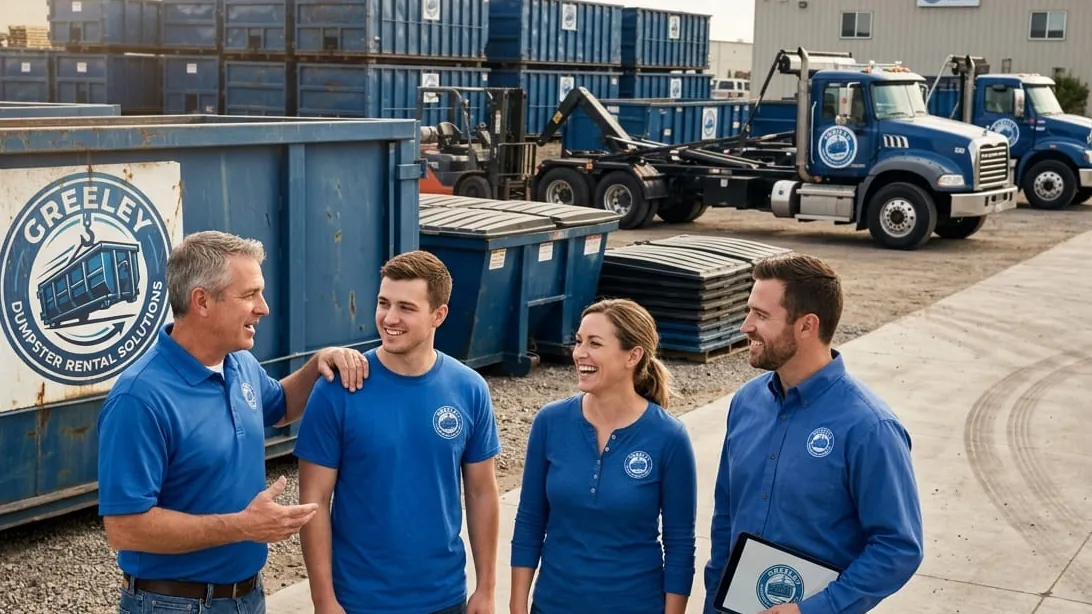
Start with the fact that decides most of this article, because it runs against what people expect: Colorado has no statewide landfill ban on yard waste. We looked for one and there is not one. Grass, leaves, branches and brush can lawfully go into a container and to a landfill in this state.
That is different from a lot of the country, and it means the yard-waste question here is not “am I allowed to?” It is “what is the sensible route for this particular pile?” — and the answer changes depending on whether your pile is genuinely green, or whether it is construction debris wearing a leafy disguise.
The second thing worth saying early: this is irrigated plains, not forest. Greeley sits at about 4,676 feet on flat ground near the confluence of two rivers, in farm country, with watered lawns and mature street trees in the older neighborhoods. The yard-waste conversation here is about lawns, gardens, hedges, shade trees and storm damage. It is not about clearing woodland.
The Greeley season starts later than you think
If you have moved here from almost anywhere east or south, recalibrate the calendar.
Greeley’s average last spring frost is 12 May. The average first fall frost is 8 October, giving a growing season of roughly 149 days. Spring cleanup does not start in March here in any meaningful way. It starts in May, and it starts for everybody at once.
That matters commercially because early May in Greeley is already the tightest fortnight of the year. The frost lifts, the university year ends and a large renter population turns over, and the City runs its two-day Annual Spring Clean-Up in the same window. If your yard project is in the first half of May, book earlier than feels necessary. The Spring Clean-Up guide explains that event.
The other peak is the fall, compressed into the weeks around that 8 October frost date: leaves come down, beds get cut back, and everyone does it in the same three weekends.
Route one: the City’s own organics site
Greeley runs the Greeley Organic Waste Center — the GROW Center, on 970-673-3718. It takes exactly the material you would hope:
- Grass clippings
- Leaves
- Plants
- Limbs and branches
- Christmas trees
- Clean wood — lumber that is unpainted and untreated
The City has moved the site in recent years, so call 970-673-3718 for the current location and hours rather than trusting an address on a web page, including ours. We are not publishing one, because two City pages give two different addresses and we could not establish which is current. The phone number is the reliable thing.
We also could not establish GROW’s hours, its charges, or whether it accepts loads from anyone other than residents self-hauling. Ask when you call.
Route two: commercial composting in the county
Weld County has permitted composting facilities on its own published list of solid waste facilities, and the nearest to Greeley is A-1 Organics, which composts at Eaton — 970-454-3492. It is a short run up the road from Greeley and it is a genuine organics operation rather than a landfill that tolerates green waste.
For a large brush or land-clearing job, that is worth a phone call before you assume the load has to be landfilled.
Route three: a container, which is fine and sometimes right
Because there is no state ban, a container is a legitimate route, and for some jobs it is clearly the best one:
- The job is mixed — brush plus an old fence plus the contents of a shed. Sorting it into three streams costs more than it saves.
- The material is not clean — treated posts, painted trellis, plastic edging, landscape fabric, old irrigation pipe, root balls full of dirt.
- The volume is large and the timing is short, and a container in the driveway beats fourteen trips in a pickup.
- It is storm debris, arriving all at once and not on a schedule.
See yard waste removal for the service side.
The clean-wood line, which is where most people trip
“Unpainted and untreated” is doing enormous work in the City’s accepted-materials list, and it is worth being blunt about what falls outside it.
Not clean wood: painted trim. Stained decking. Pressure-treated posts and rails. Plywood, OSB and engineered sheet goods. Framing with nails still in it. Anything laminated, glued or coated.
Which means a demolition pile that looks like “just wood” to the person who made it is, materially, construction debris. And construction debris is refused by name from the City’s own annual clean-up, which excludes “Construction or demolition debris (including dirt, concrete, masonry, plywood, and similar materials).” Plywood is on that list explicitly.
So a deck teardown is not a yard-waste job even though it happens in the yard. It is a demolition debris job. Storm-broken branches, by contrast, are straightforwardly green waste. The test is simple: if a person made it, it is construction debris; if a tree made it, it is green waste.
What the City’s spring clean-up does not do
Worth flagging because people assume otherwise. The Greeley Annual Spring Clean-Up’s accepted list is appliances, furniture, mattresses, scrap metal and tires. Yard waste is not on it. The City’s own clean-up notice points residents at the GROW Center for green waste instead. It is a bulky-goods event, not a garden event.
It is also two days a year, residents-only with photo ID, refuses bagged loads, and charges by the load. The Clean-Up line is 970-350-9336.
Weight, volume, and picking the right box
Yard waste splits into two categories that behave in opposite ways, and getting them the wrong way round is the classic sizing mistake.
Brush, branches and leaves are bulky and light. They fill a container by volume long before weight becomes an issue. A big pruning job or a hedge removal can justify a 20-yard, and for a large clearance with a lot of limb material a 30-yard is reasonable, because the load stays light.
Sod, soil, root balls and stumps are the exact opposite. They are dense, they hold water, and a small volume of them reaches lawful payload fast. Anything with dirt in it belongs in a 10-yard, kept separate. See heavy debris.
The trap is the mixed load — a container that starts as brush and finishes with the sod and the old patio base thrown on top. It will be over weight and under-full, which is the worst of both. If the project has a dig in it, plan for two containers or two stages.
Three practical loading notes:
- Cut brush to length. Four-foot lengths load several times denser than whole limbs. Twenty minutes with a saw can save you a container.
- Do not load above the rails. Branches above the rails cannot travel and the load has to be secured.
- Cover it. Leaves and clippings are the easiest material in the world to lose out of an open box on a windy day, and one of the landfills serving this region publishes that all uncovered or unsecured loads will be charged double.
Storm debris, which is its own category
Northeastern Colorado averages seven to nine hail days a year and sits within the most hail-prone corridor in the country. A serious hailstorm does not just damage roofs; it strips leaves, shreds gardens and breaks limbs across a neighborhood in twenty minutes. Weld County has recorded more tornadoes than any other county in the United States, mostly landspouts. And the wind here is a real force in its own right — Front Range downslope windstorms have recorded gusts of 137 mph at NCAR’s Table Mesa site in January 1982, and Weld County’s published residential design wind is a 115 mph three-second gust.
Storm debris therefore arrives all at once, in volume, unplanned, across a whole street at the same time. Two consequences: book early after a storm, because everyone else is calling too; and keep the pile off the right-of-way while you wait, because § 12-269(a) permits trash containers on the public right-of-way for one 24-hour period in seven days — the weekly curbside cart rule — and it is not authority to stack storm debris at the curb for a fortnight.
The National Weather Service Denver/Boulder office is the forecast office covering Weld County.
Two things from the garden that are not yard waste at all
Garden chemicals. Weed killer, insecticide, fungicide, pool chemicals, old fertilizer and anything else in a bottle from the back of the shed cannot go in a container. They go to Weld County’s household hazardous waste facility, 1311 North 17th Avenue, Greeley, (970) 400-2217, open Tuesday, Thursday and Saturday 8 a.m. to 5 p.m., and free to every Weld County resident. Limits: 200 pounds per household per visit, nothing over five gallons, no leaking containers, no plastic bags. Electronics and appliances are not accepted there.
Old irrigation and equipment. Sprinkler controllers and powered garden tools are electronics and appliances, and electronic devices have been banned from Colorado landfills since 1 July 2013 under C.R.S. § 25-17-303. Weld County runs separate e-waste collections.
Before you dig, and before you burn
Digging. Fence posts, stump grinding, a new bed with a trench, a tree removal that takes the root ball. All of that is excavation, and Colorado 811 applies: 811 or 800-922-1987, two business days by statute under C.R.S. § 9-1.5-103, not counting the day of notice. Colorado 811’s own homepage advises three days, so leave the margin. White-line the area first. colorado811.org
In this county that is not a formality. Weld produces more than 80 percent of Colorado’s oil and gas, and the ground carries gathering lines and flow lines that a homeowner may know nothing about — Greeley’s own development code has a section headed “Recordation of Flow Lines.” Also, on an irrigated lawn, sprinkler lines and heads sit shallow and are easy to find the hard way.
Burning. We are not publishing burning rules. Greeley amends the open-burning section of the fire code in its own chapter and does issue an outdoor burning permit, but we could not retrieve the terms of that amendment, so we will not describe them. Call the Greeley Fire Prevention Bureau on (970) 350-9510 before you light anything. Outside the city limits in unincorporated Weld County, the county adopts no fire code of its own and the question goes to the local fire protection district.
Where the container goes for a yard job
Yard work tempts people to put the box on the lawn, next to the work. Three cautions.
- Soft ground. Greeley gets only 15.34 inches of precipitation a year, measured at the Greeley–Weld County Airport station, so the ground is usually firm — but a cloudburst changes that in an afternoon, and a loaded container ruts turf badly. The placement guide covers the surfaces.
- Sprinklers underneath. Check before, not after.
- Five feet from a combustible wall. Greeley adopted the 2021 International Fire Code at § 22-454, effective 1 January 2023, with no amendment to Section 304, and under Section 304.3 a dumpster must not be stored inside a building or placed within five feet of a combustible wall. Every roll-off is over the threshold in that section. That includes the fence, the shed and the deck if they are what the box would be against.
For the street, the City is explicit: “Placement of dumpsters within the Public Space and roadways requires Public Space Traffic permits and proper signage.” Public Works Permits, 970-350-9881, 2835 W. 10th Street. See the permit guide.
The short version
- No Colorado landfill ban on yard waste. A container is a lawful route.
- Clean green waste is better composted — GROW Center 970-673-3718, or A-1 Organics at Eaton, 970-454-3492.
- “Clean wood” means unpainted and untreated. Everything else is construction debris.
- The City clean-up does not take yard waste at all.
- Brush is bulky and light; sod and soil are dense. Never mix them in one box.
- Chemicals to 1311 N 17th Avenue, (970) 400-2217, free to Weld County residents.
- Call 811 before you dig, and (970) 350-9510 before you burn.
Call (970) 888-6911 and describe the pile — branches, sod, a fence, or all three. That one sentence decides the size and the number of containers. See also the Colorado materials guide and the sizing guide. The City’s own site is greeleyco.gov.
Questions this guide did not answer? Call (970) 888-6911. We would rather spend two minutes on the phone than have you order the wrong container.