Permits
Dumpster Permits and Placement Rules in Greeley, CO
Greeley names dumpsters directly in its own permitting guidance, which is rarer than it sounds. Here is which permit applies, which does not, and who answers the phone.
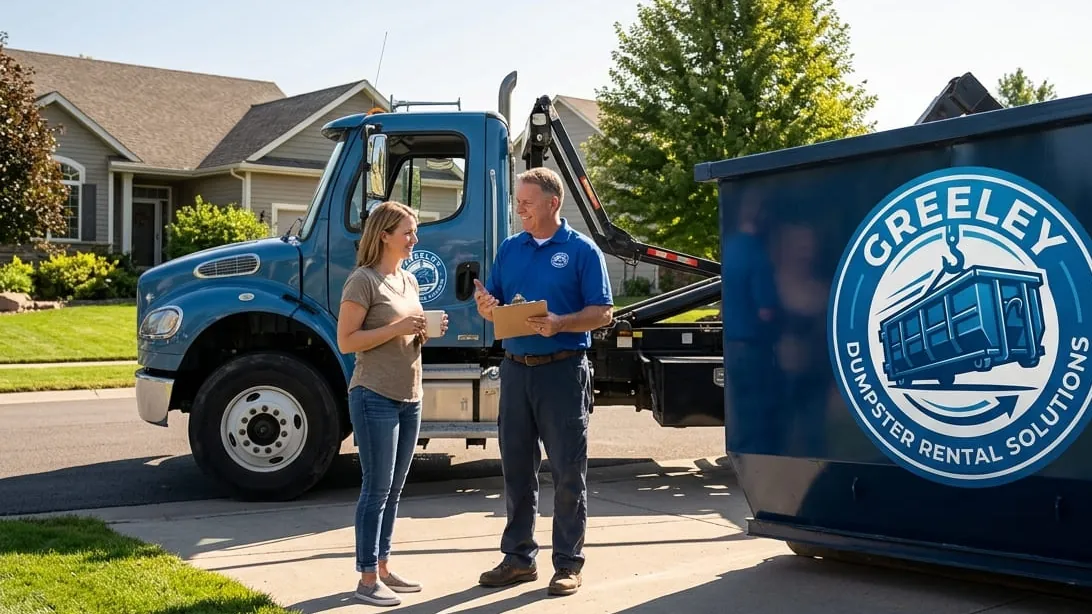
The question arrives most weeks and it always arrives the same way: do I need a permit for a dumpster in Greeley? The answer turns on one thing, and it is not the size of the container or the length of the rental. It is whose ground the box is standing on.
What makes Greeley unusual, and genuinely easier to work in than a lot of Colorado, is that the City has written the answer down and put a phone number next to it. Greeley is a home rule city, incorporated on 15 November 1885, and it does the full set of things a city can do: it adopts its own building and fire codes, it runs its own fire department, and it names dumpsters directly in its own permitting guidance. That is good news. It means there is an actual answer rather than a shrug.
On private property: no City right-of-way permit is in play
A container on your own driveway, in your own yard, or on your own parking lot does not involve the City’s right-of-way process at all. That covers the large majority of residential placements in Greeley, and it is why most deliveries here are simply deliveries.
Private property still has constraints, and they come from the fire code rather than from the permit counter — see the five-foot rule below. If you rent, or if the property is governed by a homeowners’ association or a commercial lease, that is a private permission question rather than a municipal one, and it is worth settling before delivery day.
In the street or on the sidewalk: Greeley names dumpsters expressly
Most municipal codes leave containers to be inferred from a general obstruction ordinance. Greeley does better than that. The City’s own published permitting guidance, Permitting Requirements for Activities within Public Space and Land Grading Activities, says it in a single sentence:
“Dumpster and/or Moving Container Placement within Public Space and Roadways: Placement of dumpsters within the Public Space and roadways requires Public Space Traffic permits and proper signage.”
Two things in that sentence do the work. Traffic permit: the permit type the City defines as covering “work in public space without ground disturbance that impacts mobility” — which is exactly what a container standing at a curb is. And proper signage: the City expects the placement to be marked, not just permitted.
The desk that administers it is City of Greeley Public Works Permits, at 2835 W. 10th Street, on 970-350-9881, Monday to Friday from 7:00 a.m. to 4:00 p.m., with applications submitted through the City’s online permitting portal. The City’s public space permitting page is on greeleyco.gov.
We are not going to publish a fee for it. Greeley’s permit charges are not fixed in the code — the right-of-way chapter at § 18-66 says permit application and processing fees “shall be set in writing annually by the city manager,” and the business license chapter at § 8-58 uses the same formula. They live in the City’s annual fee schedule and can change without a code amendment. Ask the permit desk what the figure is this year.
The 24-hour rule that is not a permit
There is a provision people find and misread, so it is worth drawing the line clearly. Greeley Municipal Code § 12-269(a) says:
“Nothing in this section shall prohibit the placement of trash, garbage or refuse containers for pick-up on public rights-of-way for one 24-hour period within a seven-day period.”
That is the weekly curbside rule for a household trash cart — put it out the night before, bring it in on collection day. It is not authority to leave a roll-off in the street for a day. A roll-off in the public right-of-way is governed by the Public Space permit above, not by that sentence. Anyone telling you Greeley gives containers a free 24-hour pass has read the wrong provision.
The obligation that runs the other way
The same section, at § 12-269(b), is the reason a lot of Greeley jobs need a container in the first place:
“All refuse and debris remaining as a result of the demolition or repair of any buildings or the erection and completion of any buildings shall be removed following substantial completion of the work.”
That is a municipal obligation on the property, and § 12-269 as a whole makes an accumulation a code infraction. The refuse chapter at § 8-371 adds that nothing in it relieves contractors of the duty to clean up their own work sites. Put together: in Greeley, clearing the debris is not optional and it is not the next owner’s problem.
The rest of the Public Space permit menu
The City’s permitting document lists a set of permits for work in the public space, and it is worth knowing which one you are actually in:
- Traffic Control Permit — work in public space without ground disturbance that impacts mobility, and expressly, dumpster and moving-container placement
- Potholing Permit — before excavation or boring that crosses utilities in public space
- Development Permit — construction in public space tied to a development project, after land-use review
- General Construction Permit — work on public utilities and related items such as driveways and concrete
- Oversized / Overweight Load Permit — movement of oversized or overweight loads within the city
- Tree Trimming / Removal Permit — trees in public space
- Land Grading Permit — disturbance of one acre or more, or less as part of a larger development
- Landscaping Permit — landscaping in public space, excluding mowing and annual maintenance
- Event Permit — non-construction activity in public space with ten or more attendees
Note the overweight-load permit exists, but do not read it as a suggestion that an ordinary container delivery needs one. We did not establish any Greeley weight threshold that would apply to a routine roll-off, and we are not going to imply one.
The code underneath the permit
The right-of-way machinery sits in Title 18, Chapter 1 of the Greeley Municipal Code, and a few sections are worth knowing by number.
- § 18-2: no person may commence construction, installation, alteration or repair of any sidewalk, curb, gutter, driveway, curb cut, street, alley “or any other improvement in or under a public right-of-way… without first obtaining a permit.”
- § 18-61: applications go to the city engineer, who requires proper traffic control devices on all work and may require a written traffic control plan before issuing the permit. If your job is going to close a lane on a busy street, expect that.
- § 18-69: emergency work on existing facilities in the public way may proceed without a permit where circumstances demand immediate work and a permit could not practicably be obtained beforehand.
- § 18-71: sets insurance minimums for right-of-way work — not less than $150,000 for injuries to one person, $400,000 on account of one accident, and $400,000 for property damage.
One clarification, because it trips people up. Title 8, Chapter 4 licenses public right-of-way contractors — the firms that build sidewalks, curbs, gutters, driveways and street improvements, with an annual license and a right-of-way permit bond. That chapter is about building the right-of-way, not about standing a container in it. Nobody needs a public right-of-way contractor license to have a dumpster delivered.
The whole code is published at the City’s Municode library, and Greeley 311 on (970) 351-5311 will route any question you cannot place.
The fire code separation, which applies everywhere and to every container
This one is not a permit and there is no application. It is a placement rule and it applies on private property as much as in the street.
The City of Greeley has adopted the 2021 International Fire Code at Greeley Municipal Code § 22-454, effective 1 January 2023, and the Greeley Fire Department confirms it in its own words: “The City of Greeley and the Western Hills Fire Protection District have adopted the 2021 International Fire Code, except as amended in the City of Greeley Municipal Code.” Greeley makes no amendment to Section 304, so the model container rules apply exactly as written.
Under Section 304.3, a dumpster must not be stored inside a building or placed within five feet of a combustible wall. Every roll-off we place is far over the size threshold in that section — a 10-yard box is ten cubic yards — so the five-foot rule applies to all of them. There is nothing to debate about thresholds; keep it five feet off the siding, the fence, the eave line and the garage.
The Greeley Fire Department is a City department with seven stations, and its Fire Prevention Bureau answers placement questions on (970) 350-9510. If you want a specific placement blessed before delivery, that is the number.
The enclosure standard that does not apply to you
Commercial and multifamily sites in Greeley are designed to Development Code § 24-1058, which requires a trash receptacle sized for the uses, sited so it does not block circulation or sight lines, out of front and side setbacks, accessible to refuse trucks, and — where the receptacles occupy more than 15 square feet in aggregate — “enclosed on at least three sides by a solid wall or fence six feet in height and by a solid gate no less than five feet in height on the fourth side,” architecturally compatible with the building, lids kept closed.
That is why Greeley’s permanent dumpster corrals look the way they do. It is a site design standard for permanent service, and it does not require you to build a wall around a temporary roll-off on a driveway. It is, however, a good argument for a temporary container on a commercial job: an enclosure sized for a restaurant’s daily waste is not going to absorb a tenant-finish tear-out, and the code expects the permanent receptacle to be sized for the ordinary uses of the site.
Historic districts, and what we can and cannot tell you
Greeley has two locally designated historic districts. The Monroe Avenue Historic District was the City’s first, designated 13 December 1999, with a published boundary of “9th Ave. from 11th St. to 16th St., roughly.” The Downtown Greeley Historic District followed on 25 November 2002, published as “7th to 10th Streets between 8th and 9th Avenues, and including the Weld County Courthouse, Lincoln Park and Greeley High School.” The City’s local historic register runs to 102 properties.
What we could not establish is what work in one of those districts triggers design review, or what the review process is. So we will not tell you. If your property is designated or sits inside a district, call Greeley 311 on (970) 351-5311 before exterior work or demolition. Historic Greeley Inc., on (970) 302-8368, is based in the Monroe Avenue district and knows the neighborhood well.
Outside the Greeley city limits, the answer changes
This is the part national guidance always gets wrong. Greeley’s rules stop at the city limit.
Unincorporated Weld County. The county requires permits for construction activities within county rights-of-way, and the language it uses is broad, covering occupation as well as excavation. Weld County Public Works handles right-of-way permits from 1150 O Street, Greeley — (970) 400-4000. The county’s published material does not name dumpsters, so we will not tell you the county requires a permit for one; we will tell you the language is broad and a phone call is warranted. Note also that Weld County adopts no fire code of its own — its ordinance provides that the International Fire Code applies only when adopted by a local fire district — so out there the container-placement question goes to whichever fire protection district covers the address, not to the county.
The separate towns. Evans, Eaton, La Salle, Kersey, Ault, Platteville and Garden City each have their own government and their own rules. We did not establish any of them, and we will not assume Greeley’s rules apply. Tell us the address and we will tell you which desk to ring.
Garden City deserves its own line: it is a statutory town of about 72 acres and 254 people, incorporated in 1938 and completely surrounded by Greeley and Evans. Cross one street and you are in a different municipality. If your address is in Garden City rather than Greeley, say so, because the permit questions are different — and we will not guess at what the answers are.
If you are digging, not just placing
Placing a container is not excavation. But if the job itself involves digging — footings, a sewer lateral, fence posts, a stump — call 811 or 800-922-1987 first. Colorado law requires two business days’ notice under C.R.S. § 9-1.5-103, not counting the day you give it, and it requires you to white-line the area before requesting the locate. Colorado 811’s own homepage advises three business days, which is longer than the statute and is good practice; either way, give notice before you dig.
Weld County is dense with buried lines beyond the ordinary utilities — Greeley’s own development code carries a section headed Recordation of Flow Lines, and the county produces the majority of Colorado’s oil and gas. A property may have gathering or flow lines crossing it that nobody living there knows about. The state regulator is the Energy and Carbon Management Commission.
The short version
- Driveway, yard, private lot: no City right-of-way permit. Keep it five feet from anything combustible.
- Street, sidewalk, public space: Public Space traffic permit and proper signage. 970-350-9881.
- Unsure which you are in: Greeley 311, (970) 351-5311.
- Placement against a wall: Greeley Fire Prevention, (970) 350-9510.
- Outside the city limits: tell us the address first.
Call (970) 888-6911 and describe where the box needs to go. If it needs to go in the street we will tell you so before delivery day, not after. More on the neighboring desks in who do I actually call, on sizing in the Greeley sizing guide, and on surfaces in the driveway protection guide. Our FAQ page collects the rest.
Questions this guide did not answer? Call (970) 888-6911. We would rather spend two minutes on the phone than have you order the wrong container.