About us
Locally Owned Dumpster Rental in Greeley Since 2013
A used truck, four cans and a landline, in a city where the housing was already old and the county permit counter sat six blocks away. Here is how Greeley Dumpster Rental grew out of that, and why Marcus Hale is still the one who picks up.
Our story
It started in the basement of a north-side ranch house
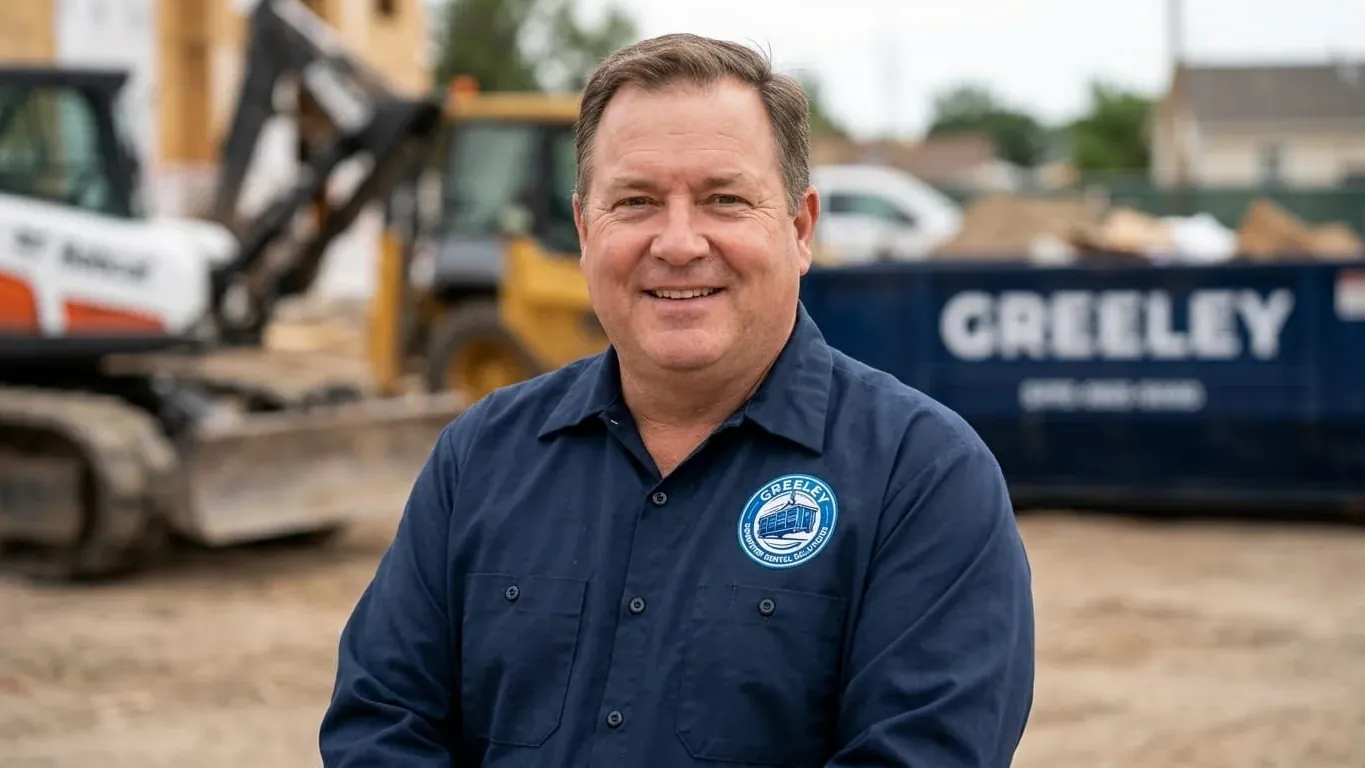
Marcus Hale grew up out here, in a ranch house on the north side with a full basement under it, and joined a local remodeling crew the summer he left school. Most of his twenties went by underneath Greeley houses — lifting cabinets out of kitchens nobody had touched since the seventies, stripping hail-struck shingle through August, breaking out footings and retaining walls, emptying lower levels that had held thirty years of everything — and the same two failures kept happening on job after job. The container arrived late, or it arrived and the invoice had grown since the phone call. Nobody ever sits a homeowner down and explains that block, brick and mortar reach lawful transport weight in a box that still looks part used, or that a tear-off is measured in squares and layers rather than by the area of the roof. So the can that sounded generous on the phone is at payload halfway up, and then it stays in the driveway because it is too heavy to lift.
In 2013 he put money down on a used roll-off truck and four containers, parked the lot of it on 514 14th Ave, and answered the phone himself. Marcus is still on most of those calls and still keeps the dispatch board. Job number one was a hail tear-off a few blocks away, for a homeowner whose previous hauler had canceled on her twice while the roofing crew sat on the ridge waiting for a box. She is still a customer, and she still tells that story to anybody who asks.
Word travels here the way it always has: through contractors, through neighbors over a fence, through whoever is behind the supply counter mentioning that the dumpster people actually showed up. Three facts about this particular city then did the rest. Hail — seven to nine days a year in the corridor NOAA ranks the most hail-prone in the country — can put a fortnight of roofing on the board across one weekend. The age of the housing. The median Greeley house dates from 1985 and roughly 46 percent of the stock is older than 1980, so kitchens, bathrooms, roofs, sewer laterals and lower levels come due in a steady rhythm year after year instead of arriving in a boom. And the first half of May, when the average last frost on 12 May, the end of the university year, and the City’s own two-day Spring Clean-Up all fall inside the same fortnight — and every landscaping, fencing, turnover and outdoor demolition job in the market piles into it. Trucks got added as the calls came in, never against volume we had not earned yet. 13 years later it is a small fleet, still dispatched off 514 14th Ave, and the phone still lands on a desk with somebody local sitting behind it.
Why the quote matters more than the truck
This trade has an image problem and it earned every bit of it. A teaser rate on the website, a tonnage allowance tucked into the small print, then an invoice carrying an overage line nobody mentioned on the phone. We built the pricing against that from the first week. The four questions are always the same: what is going in, what does it weigh, how many days do you want it, and where does it stand. What comes back is one number covering the drop, the pull, the window and the disposal. And if the size you have asked for is wrong, you get told — including on the occasions when the wrong one is the more expensive one.
What local buys you that a logo does not
It is a working fact rather than a slogan. It means the dispatcher already knows which rear alleys behind the older blocks will swallow a 20 and which will not; which streets in the Monroe Avenue and downtown districts are too tight to put anything on the pavement at all; and, above everything else, which rulebook your address sits under. Inside the city limits that is a genuinely good answer, because Greeley has a counter and a number: the City licenses refuse haulers under § 8-368, names dumpsters directly in its Public Space permitting guidance, adopted the 2021 International Fire Code at § 22-454, runs seven fire stations of its own, and answers everything else on Greeley 311, (970) 351-5311. Step outside the limits and the answers change — Weld County adopts no fire code of its own and leaves that to the local district, Garden City is a separate town of 72 acres with a government of its own, and Lucerne, under four miles north in a straight line, is unincorporated ground with no municipal government at all. It also means we can guess within a size what a house sitting on a 30-inch frost line, with a full basement and three decades of storage under it, will actually produce on the day it gets emptied. And it means that when a hailstorm crosses the county and half the city wants a box in the same seven days, the trucks are already parked in it.
At a glance
- Trading since2013
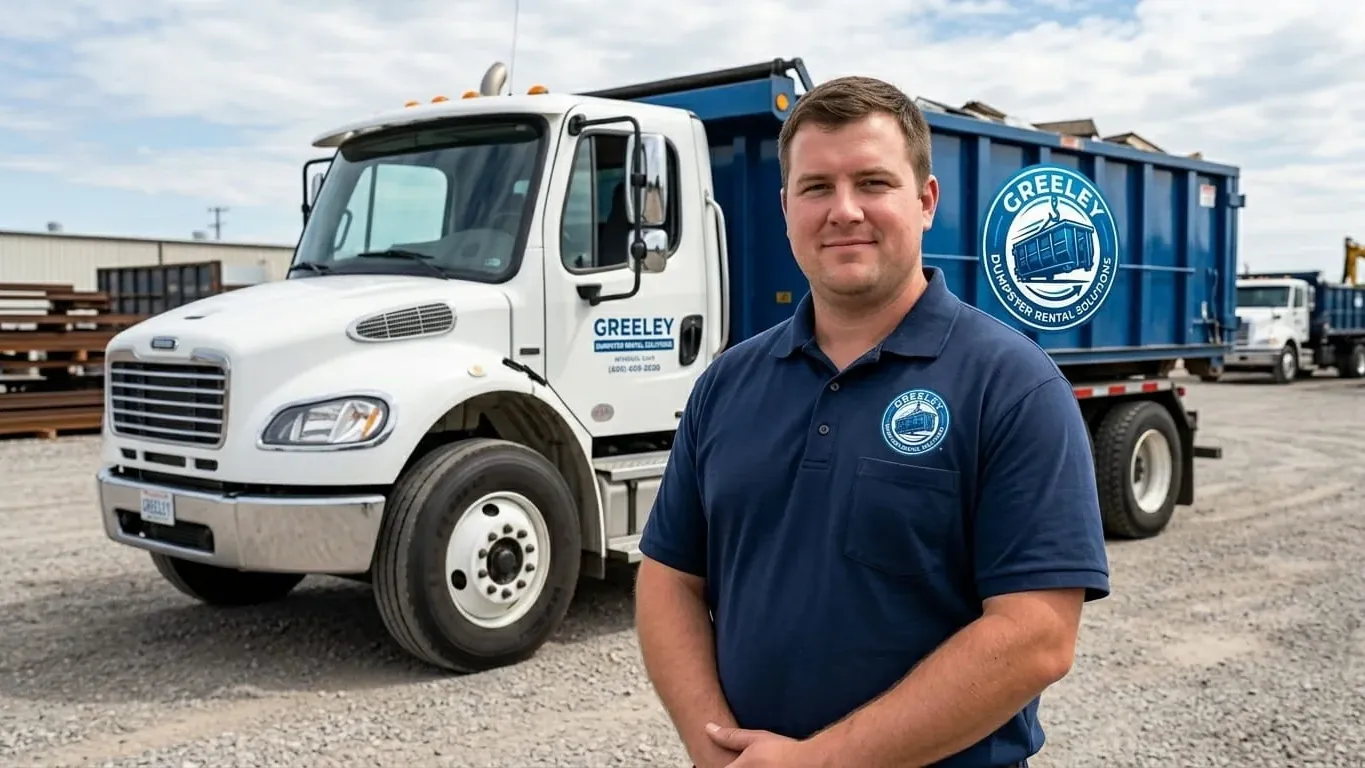
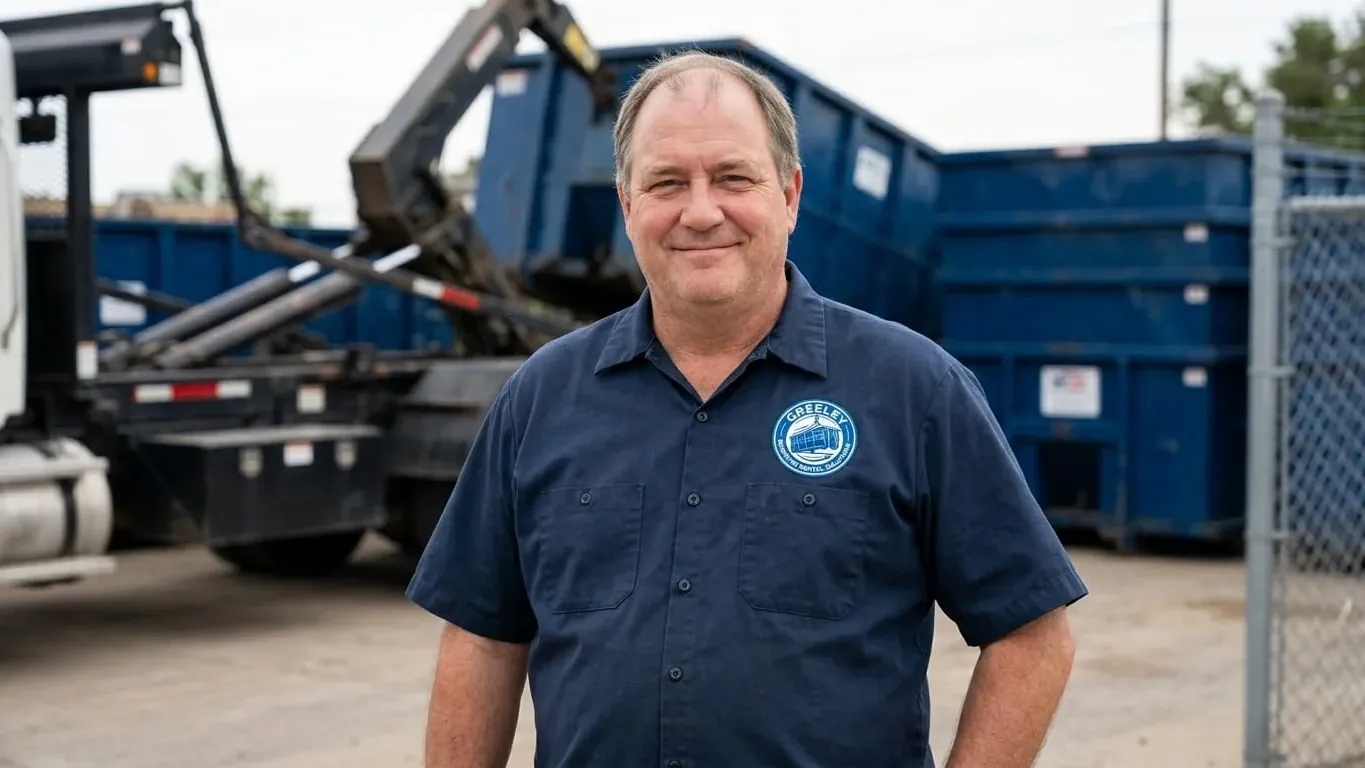
- Run byMarcus Hale
- Yard514 14th Ave
- Boxes we run10, 15, 20, 30 and 40 yd³
- How far outRoughly 35 miles
- CoverCommercial, on every load
Our values
Six things that are not up for negotiation
The figure does not move
Whatever gets said on the phone is what appears on the invoice. If the size turns out wrong, that error is ours to carry and not yours to pay for.
A window is a window
When something does go sideways — and occasionally it does — what you get is a phone call telling you so, rather than an afternoon of silence.
The property goes back as we found it
Boards down before the box lands, the drop walked on foot first, and a driver who will move a can rather than stand in the drive arguing about where it ended up.
Sorted before it is buried
Metal, clean wood, cardboard and green material get pulled and recovered wherever we can manage it, and you will be told to lift the salvage out before we arrive. It saves you money, because every pound crossing the scale is charged by the ton — and electronics have to leave the load whatever happens, since Colorado will not permit them in a landfill.
You hear the awkward part first
If the job is really two hauls rather than one, or there is a call to the City permit desk that nobody has mentioned to you, that conversation happens before the truck is loaded.
The neighbors know where we live
Because we live here too, and our kids are in the same schools. There is no head office three states away to hide behind when something goes wrong.
Experience
What 13 years of Greeley driveways teaches a dispatcher
The four expensive mistakes, in the order they cost money
One: sizing by how much room it takes when the debris is dense. Concrete, block, brick and mortar all reach payload while the box still looks part used. Two: putting a hail tear-off in too big a can. Shingle is counted in squares and layers, and it makes lawful weight long before it fills a 30. Three: forgetting the downstairs. A clear-out that reads like a 15 on the main floor is a 20 by the time the lower level and the garage go in it. Four: assuming somebody else absorbs the overflow — when in fact the City runs no collection truck at all — under § 8-371 it is “the sole agency for the collection and disposal of refuse” acting through “city-licensed operators” — and its own Spring Clean-Up turns construction and demolition debris away at the gate. All four are avoidable inside one honest phone call, which is the entire reason we make you have it.
What has gone through these boxes: lower levels and garages out of houses nobody had emptied since the day they were finished; rental turnovers where a unit changes hands and a year of living leaves in a week; hail weeks when an entire street re-roofs together; wind damage that took the fence line, the shed and half the soffit in one night; flood and storm work where the drywall came off to four feet and the insulation followed it; deck and outbuilding tear-offs where the footings came up with the frame; kitchen and bathroom gut-outs in sixties and seventies ranch houses; aprons, foundation repairs and retaining walls broken into 10 yard cans; spoil out of 30-inch trenches that weighed a great deal more than anyone expected; new-build cleanup on the newer ground out west; storefront and restaurant fit-outs downtown; and estate clearances where a family had a fortnight and a set of keys. Every one of those behaves differently once it is over the scale, and knowing that beforehand is most of what we are for.
Cover, paperwork, and what happens to a load
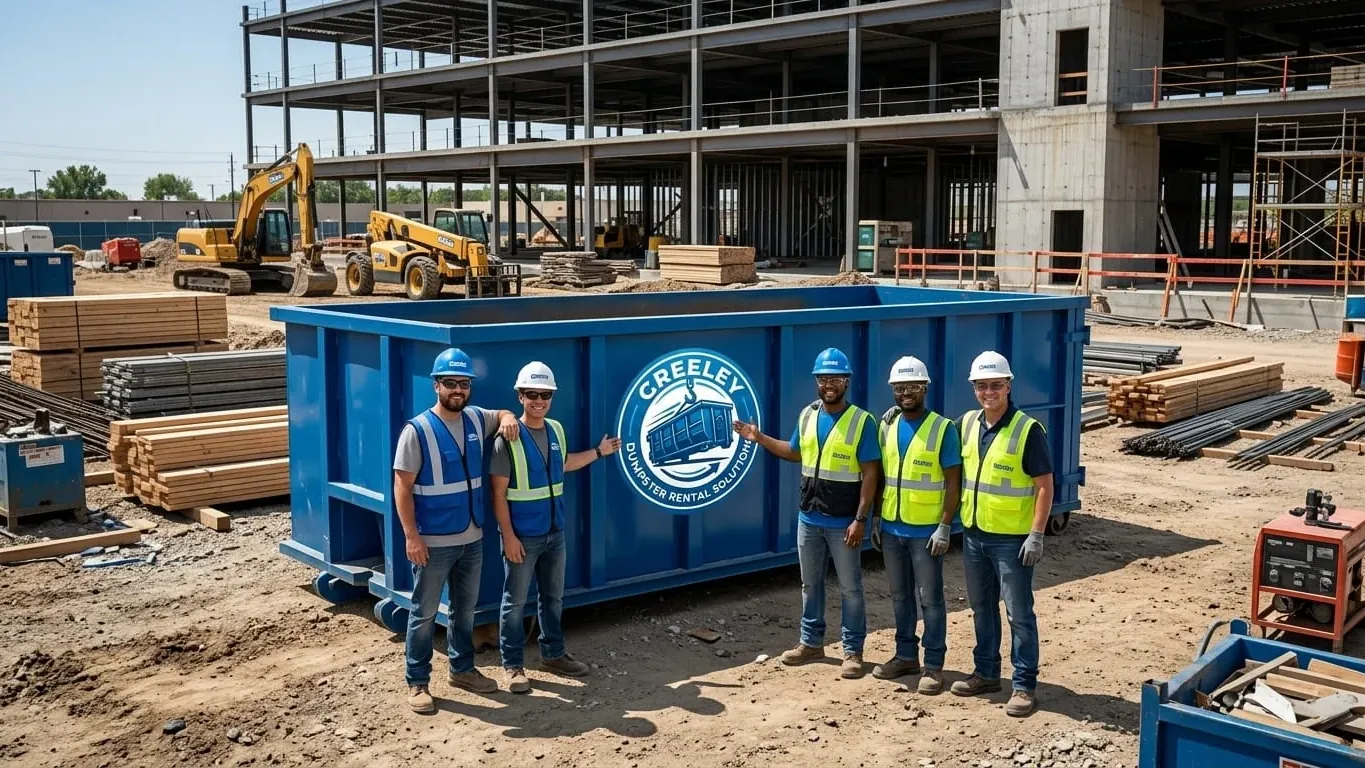
- Commercial general liability and commercial auto in force, with certificates issued on request to general contractors and property managers — and an additional insured endorsement added wherever a contract asks for one
- Every driver who takes a truck out is covered by workers’ compensation
- Loads go to permitted facilities and nowhere else. In this state a disposal site runs on a certificate of designation the county grants under C.R.S. § 30-20-102 with the state reviewing it, and each site fixes what it will accept in its own approved operating plan — there is no statewide schedule to fall back on
- Flattened corrugated and scrap metal come out of the box and go for recycling; electronics come out because C.R.S. § 25-17-303 has kept them out of Colorado landfills since 1 July 2013. Both take weight off a bill that is settled by the ton at the gate
- No liquids, no tires and no asbestos in any container we own; every load covered and strapped before it leaves the site, because a market carrying a 115 mph design wind and recorded chinook gusts of 137 mph is no place for a heaped one; and clean concrete, brick and rock kept out of mixed loads entirely
Setting up a trade account? Ask for the certificate of insurance at the same time — it is normally in your inbox before the end of the day.
Community
We live in Greeley rather than merely parking here
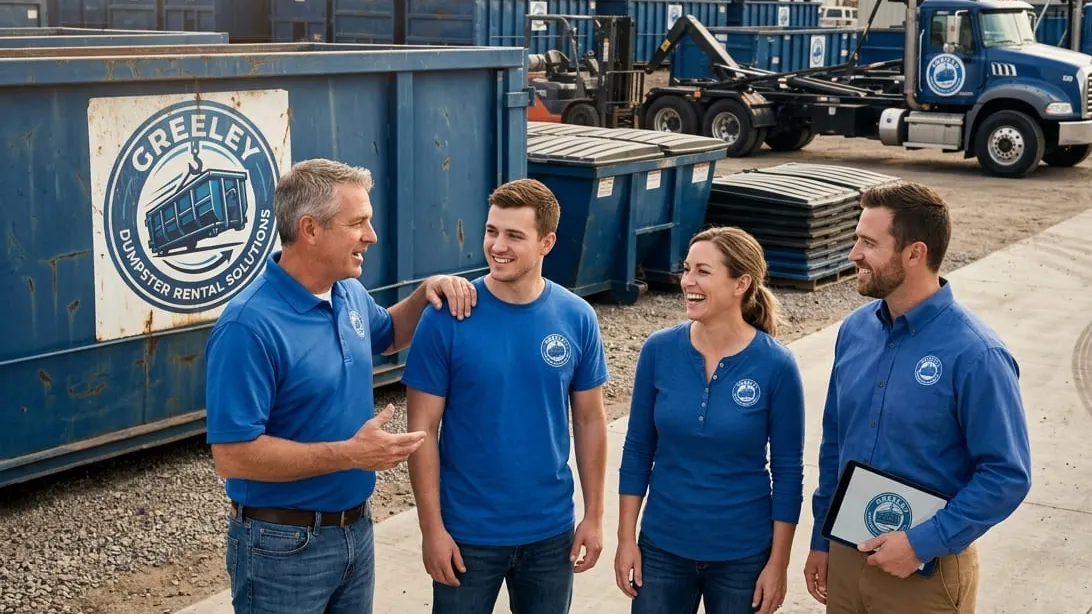
Container time gets donated to school and church clean-up days. Storm work is discounted for older residents on fixed incomes when a tree comes down on them. And we put our name on a couple of youth teams, which in practice mostly means hauling nets around at weekends. None of that is remarkable — it is simply what a business this size does in a city this size.
Greeley is an old city sitting in the newest, fastest-growing county in Colorado, and both halves of that shape the work. It began as the Union Colony in 1870, organized by Nathan Meeker, agricultural editor of Horace Greeley’s New York Tribune, on ground bought near the confluence of the South Platte and the Cache la Poudre. Membership cost $160, more than three thousand people wrote in and about seven hundred were selected, and the colonists dug their first ditch the summer they arrived — the ten-mile town ditch, Greeley Number 3, completed on 10 June 1870. By 1888 the colony’s three main ditches watered 90,000 acres. The town incorporated on 15 November 1885. Today it is a home rule city of 49.09 square miles at 4,676 feet, with about 115,073 people, the University of Northern Colorado and its 8,807 students at 501 20th Street, Aims Community College out at 5401 W 20th Street, JBS USA headquartered here, and the Greeley Stampede at Island Grove Regional Park every summer. And it is the seat of Weld County — 3,984.94 square miles, Colorado’s third largest, 378,426 people, more than 80 percent of the state’s oil and gas and $2.38 billion in agricultural sales — which means the county administration, the building department, planning and the right-of-way desk are all at 1150 O Street here in town, and the 1917 courthouse at 9th Street and 9th Avenue, designed by William N. Bowman and on the National Register since 9 January 1978, stands inside the City’s own Downtown Greeley Historic District. County government is physically embedded in the oldest protected block in the city. The housing tells the other half of the story: the median Greeley home was built in 1985, roughly 46 percent of the stock predates 1980 and 7.2 percent dates from 1939 or earlier, so pre-1978 lead paint and pre-1989 asbestos are ordinary questions on ordinary jobs here rather than exotic ones — and they cluster where you would expect, in the Monroe Avenue district designated in 1999, the Downtown district designated in 2002, and Glenmere, whose Fairacres subdivision was developed from 1919. Four hazards shape the work: hail, chinook wind, tornado, and river flooding out of a cloudburst. No county in the United States has logged more tornadoes than Weld County — short-lived landspouts on the Denver convergence zone, for the most part — and in September 2013 the South Platte and the Cache la Poudre flooded low-lying neighborhoods here and in Evans, where the wastewater plant was heavily damaged and two mobile home parks were destroyed. A separate Poudre breach in June 2014 pushed water into the city near 35th Avenue and F Street. Our runs go out to the districts inside the city — downtown, Monroe Avenue, Glenmere, the streets around UNC, the West 10th Street corridor, west Greeley and the Promontory area — to the separate Weld County towns of Garden City, Evans, La Salle, Eaton, Kersey, Ault and Platteville, each with its own government and its own answers, and out onto unincorporated county ground at Lucerne, Galeton and Gill, where no municipal government exists at all. All that housing throws off debris, and we would rather less of it stayed buried — which is why scrap metal, clean wood, cardboard and clean concrete get pulled out instead of the whole lot going over the scale, why electronics leave every load because this state will not have them landfilled, and why we tell people to lift the salvage before we arrive: the solid doors, the hardware, the fixtures somebody else would happily take.
About Greeley Dumpster Rental
Who owns Greeley Dumpster Rental?
Marcus Hale. He started it in 2013 and still runs it off the yard on 514 14th Ave. The company is independently owned: not a franchise of a national chain, not a broker reselling capacity on somebody else’s trucks, and not a call center handing your job to whoever bid lowest before breakfast.
Are you a broker or do you own your trucks?
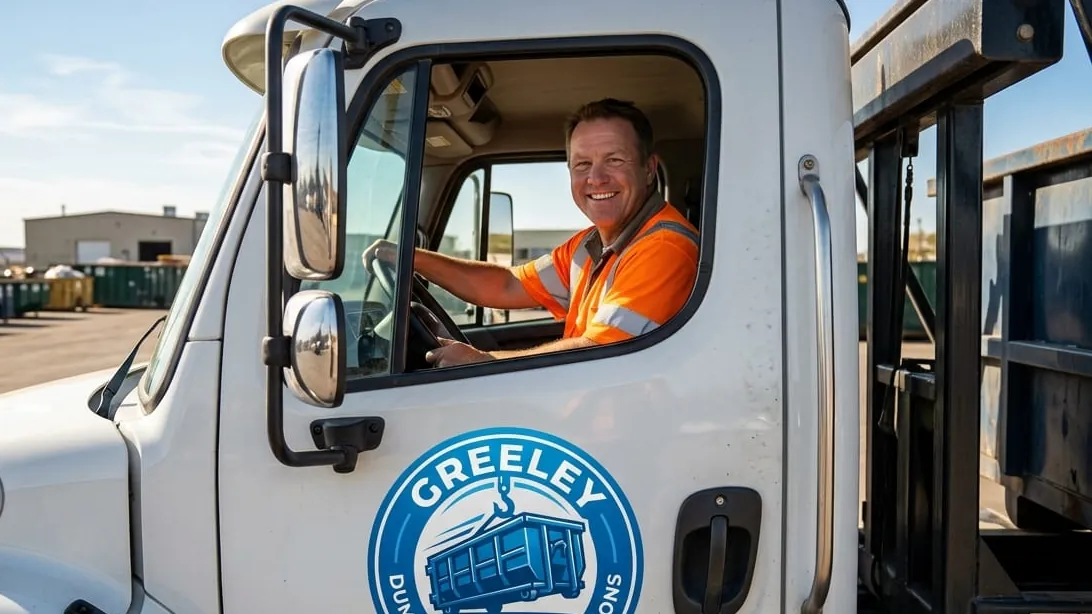
The trucks are ours, the containers are ours, and the drivers are on our payroll. It matters for one practical reason: a broker cannot honestly commit to a delivery window, because the job is being handed to a third party and hoped over. When somebody here says Tuesday morning, the dispatcher is looking at one of our own trucks on the board.
What areas do you actually serve?
Greeley and roughly a 35 mile radius, and every one of the seventeen places we cover is in Weld County. One county, one seat, one set of county answers — but three genuinely different local ones. Seven are districts inside the Greeley city limits: downtown, Monroe Avenue, Glenmere, the streets around UNC, the West 10th Street corridor, west Greeley and the Promontory area off Highway 34. Inside the limits the City is the government in every sense that touches a container: it licenses refuse haulers under § 8-368, it names dumpsters in its Public Space permitting guidance, it adopted the 2021 International Fire Code at § 22-454 and it runs seven fire stations. One number for all of it — Greeley 311, (970) 351-5311. Seven are separate Weld County municipalities — Garden City, Evans, La Salle, Eaton, Kersey, Ault and Platteville — each with a town or city government of its own. Garden City is the striking one: a statutory town of 72 acres and about 254 people, incorporated in 1938 and completely surrounded by Greeley and Evans. Cross one street and you are answering to a different government. We have not verified what any of those towns require of a container, so we give you the town’s number rather than guess, and we never assume Greeley’s rules travel. And three are unincorporated county communities — Lucerne, Galeton and Gill — with no municipal government at all. Out there it is Weld County at 1150 O Street, (970) 400-4000 for a county road, and the local fire district rather than the county for anything about placing a container against a structure, because the county adopts no fire code of its own. Lucerne is the sharpest illustration of the whole thing: under four miles in a straight line from a home rule city with seven fire stations to ground with no municipal government whatsoever. Our full service area is listed here.
Are you insured?
Yes — commercial general liability, commercial auto and workers’ compensation, all in force. A contractor or property manager setting up an account can ask for the certificate then, with an additional insured endorsement where the contract requires one, and it is normally back the same day. That is an insurance question and we can answer it plainly. What any given jurisdiction requires of any given arrangement is a question for that jurisdiction rather than for us — Greeley 311 on (970) 351-5311, Weld County on (970) 400-4000, and each of the separate towns on its own number.
Do you handle commercial accounts?
We do: builders, remodelers, roofers, property management firms, restaurants, retail and landlords. A standing account brings priority on the schedule, next-day swap-outs and one consolidated invoice a month. In a city where 39.1 percent of Greeley households rent, against 22.1 percent across the county, turnover is a whole segment of the work rather than an occasional call. See commercial dumpster rental, or ring and we will open one.
Talk to a real person
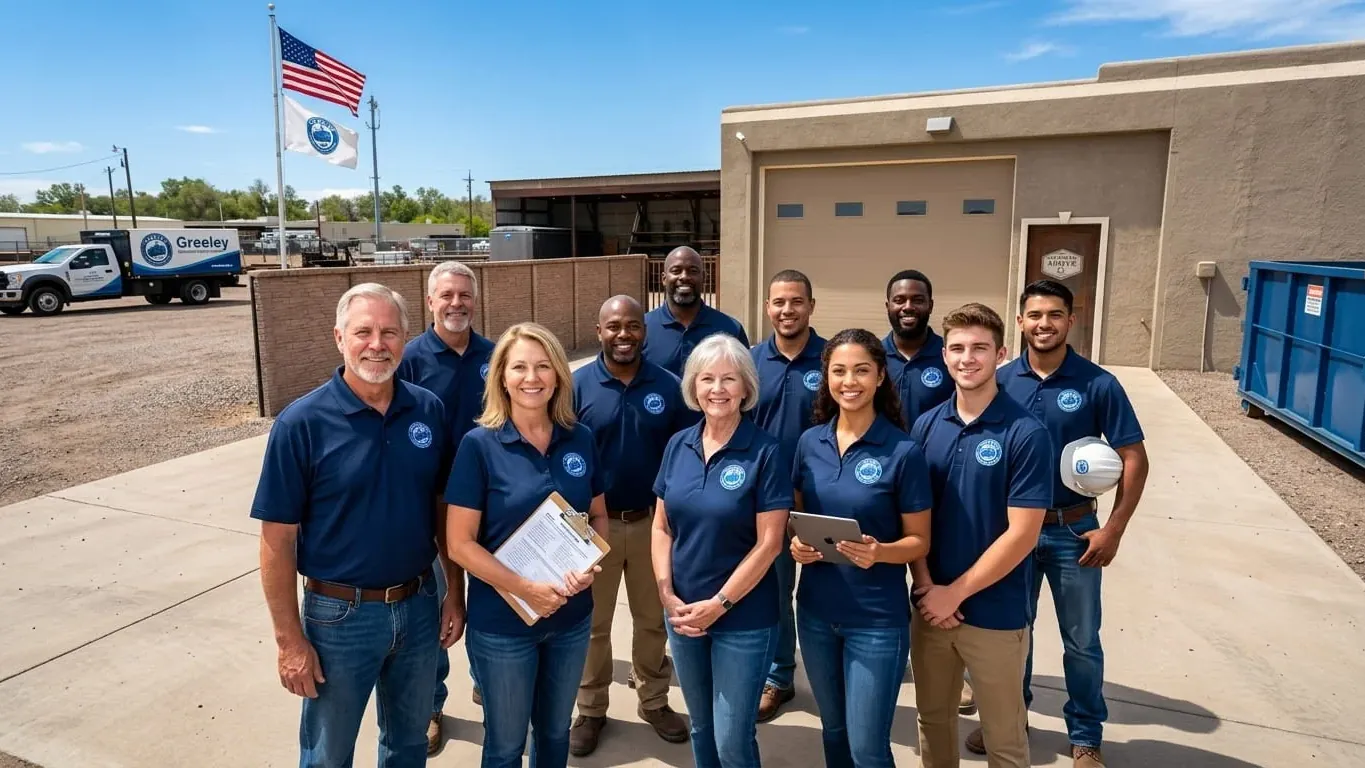
Talk to Marcus or one of the team
No queue, no chat bot, and no web form promising somebody will respond inside one business day. Dial the number and somebody in Greeley answers it.
Greeley and every one of the seventeen places we run to in Weld County · Mon–Fri 6:30am–5pm, Sat 7am–1pm