
Roofing
Roofing Dumpster Rental in Greeley, CO
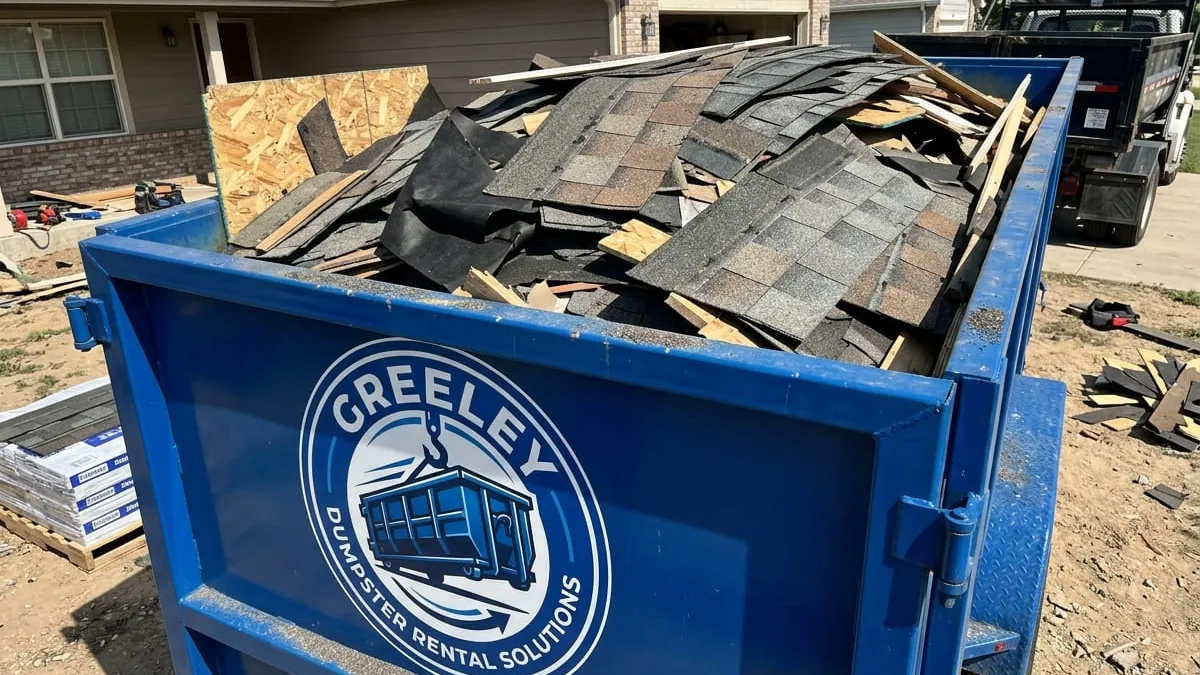
Tear-off containers for Greeley roofers and homeowners in the most hail-prone corridor in the country. Sized on squares and layers rather than on the footprint of the house — and roofing never goes in a 30 or a 40.
Roof work in Greeley is a hail business, and the numbers are not marginal. NOAA’s Colorado state climate summary puts northeastern Colorado — exactly where Greeley sits — at seven to nine hail days a year, inside what it describes as the nation’s most hail-prone corridor. The Insurance Information Institute, citing NOAA Storm Prediction Center data, ranked Colorado sixth in the country in 2025 with 244 large-hail events. The forecast office for Weld County is NWS Denver/Boulder. That does not arrive evenly through the year. It arrives in bursts, a neighborhood at a time, and the fortnight after a serious storm is the hardest two weeks of the year to get a container delivered anywhere in northern Colorado. If your roof took a hit, the sequencing matters more than the size of the box — our hail and tear-off guide sets out the order.
Greeley’s housing stock makes its tear-offs heavier than a newer market’s. The median Greeley home was built in 1985, roughly 46 percent of the stock predates 1980, and nearly 29 percent of it went up between 1960 and 1979. A house that age is on its second, third or fourth roof covering, and where a previous crew went over the top instead of tearing off, the debris roughly doubles. Two layers of asphalt shingle is dense, non-compressible material that arrives in a single afternoon, and it reaches a lawful road payload while the container still looks like it has room in it. That is the whole reason roof sizing works differently from every other job we quote.
So we size a roof the way a roofer does, on squares and layers rather than on the footprint of the house. A square is a hundred square feet of roof surface, and roof surface is always larger than the plan area because of pitch, dormers, hips and overhangs. Count the squares, count the layers, and say whether the decking is coming off with the shingle — because plywood or plank decking changes both the volume and the character of the load. Add the tear-off extras that people forget when they estimate: felt, ice-and-water shield, drip edge, ridge vent, valley metal, flashing, and very often the gutters and downspouts as well.
The rule that follows is firm and we would rather say it plainly than sell you a bigger box. Roofing never goes in a 30 or a 40. An ordinary single-layer asphalt tear-off on a Greeley house fits a 15. A large roof, a two-layer tear-off, or a job with the decking coming off is a 20. Beyond that the answer is a second pull, booked before the crew starts rather than discovered at noon — never a larger container. A big box a third full of shingle is a truck that cannot lawfully leave the driveway, and the cost of that discovery lands on the day the crew is standing on the roof.
Placement on a roofing job is its own problem, because the box wants to be close to the work and the fire code wants it away from the wall. Greeley adopted the 2021 International Fire Code at § 22-454, effective 1 January 2023, and makes no amendment to Section 304 — so Section 304.3 applies as the model code writes it: a dumpster must not be stored inside a building or placed within five feet of a combustible wall. Every roll-off we place is far over the size threshold in that section, so the five-foot rule applies to all of them, without exception and without argument. The Greeley Fire Department is a City department with seven stations, and its Fire Prevention Bureau answers on (970) 350-9510. Inside the city limits this is a City question — Greeley 311, (970) 351-5311. Call the yard on (970) 888-6911 with squares and layers and we will size it in one call.
Roofing Jobs We Set Containers For
Hail-Damage Tear-Off And Replacement
The anchor job in this market, and it arrives in bursts rather than evenly. Shingles, felt, ice-and-water shield, drip edge, ridge vent, flashing and often the gutters, all in one afternoon. Book the container before the crew is scheduled, not after.
Two-Layer And Three-Layer Tear-Off
Common on Greeley houses from the sixties and seventies, where an earlier crew roofed over instead of stripping. Every added layer roughly doubles the weight of the load, and it is the single most common reason a booked size turns out to be wrong.
Tear-Off With Decking Replacement
Rotten or undersized decking coming off with the covering. It changes the load in both directions — more volume from the sheathing, more weight overall — and it is worth telling us at booking rather than at the second pull.
Wind And Storm Roof Repair
Chinook downslope winds are a Front Range fact and Weld County publishes a 115 mph basic residential design wind speed. Partial tear-offs, blown ridge caps, lifted sections and the debris strewn across the yard with them.
Flat And Low-Slope Roof Replacement
Built-up, modified bitumen, single-ply and the insulation board beneath it. Heavier and messier than pitched work, and gravel-surfaced built-up roofing is dense enough to want the small box loaded flat.
Commercial Roof Replacement
Larger square counts, restricted lot placement and often a staged program over several days. Usually two or three containers on a rhythm rather than one large one, for the same weight reason that governs a house.
Solar Removal And Reroof
Panels and racking off, roof replaced, panels back on. The racking, flashing and old penetration hardware are ordinary container content; the panels themselves are not, and need routing separately.
Gutter, Fascia And Soffit Replacement
Frequently done with the roof and frequently forgotten in the estimate. Light, bulky and awkward, and it takes up more room in the box than its weight suggests.
Which Size For A Greeley Tear-Off
Count squares, count layers, and say whether the decking is coming off. An ordinary single-layer asphalt tear-off on a Greeley house is a 15 yard — that is the roofing workhorse in this market and it is the right answer far more often than any other. A large roof, a two-layer tear-off, or a job with decking coming off is a 20 yard. A small roof, a garage, a shed, a porch or a repair section fits a 10, and gravel-surfaced built-up roofing belongs there too because it is dense enough to run out of payload early. Beyond a 20, the answer is a second pull rather than a bigger box — roofing never goes in a 30 or a 40. Torn shingle does not compress and reaches lawful road weight long before it reaches the rail, so a large container is a container that cannot legally be hauled. Book the second pull in advance if the square count is high; discovering it at noon on tear-off day costs a crew half a day. The sizing guide works the arithmetic through.
10 Yard Dumpster
Slab, block, brick and footing spoil — it reaches payload with the box still half empty.
View this size →15yd³15 Yard Dumpster
One single-layer hail tear-off, or one room of an older house taken back to the studs.
View this size →20yd³20 Yard Dumpster
The box that leaves our yard most: a basement and a garage cleared in one fortnight.
View this size →The Five-Foot Rule And Where The Box Actually Goes
A tear-off wants the container close to the work, and there are three things that decide where close actually is. The five-foot rule comes first. Greeley adopted the 2021 International Fire Code at § 22-454 and made no amendment to Section 304, so Section 304.3 governs: no dumpster stored inside a building, and none placed within five feet of a combustible wall. Every roll-off is far over the threshold in that section, so on a roofing job the box goes five feet off the siding, clear of openings and clear of the eave, even though the shortest throw would put it against the house. Placement questions go to Greeley Fire Prevention, (970) 350-9510. The surface comes second. Plywood under the wheels and the rear rollers on every delivery, on the driveway rather than the lawn, because a container that is being loaded from a roof takes repeated impact loads rather than a steady fill. The wind comes third. Loose shingle and felt in an open box is exactly what a chinook wants, and one of the landfills serving this region publishes that all incoming loads are subject to random inspection and that all uncovered or unsecured loads will be charged double — so tarp it before the crew leaves for the day. Finally, load flat. A tear-off loaded in a heap in the middle wastes the ends of the box and puts the weight where the truck likes it least. If the box has to stand in the street, that is a Public Space traffic permit and proper signage from Public Works Permits, 970-350-9881. Two more things from the same section of the fire code that matter on a roofing job. Containers over forty gallons have to have lids, which is why loose combustible waste does not simply sit in an open bin against the building. And materials liable to spontaneous ignition — oily rags, sealant-soaked cloths, cleaning waste — belong in a listed disposal container rather than loose in the roll-off. That is a genuine jobsite fire cause and it costs nothing to get right.
Landed on the wrong page? Describe the job down the phone and you will be pointed at the right container, even where that means a different service entirely. Ring (970) 888-6911.
Get one flat number
Two minutes on the phone buys a size, a figure and a slot on the board. Nothing to fill in.
(970) 888-6911Sizes that suit it
How it works
Roofing Dumpster Rental in four steps
- 1
Tell us the job
Two minutes, and a cross street and an avenue is enough to place you on this grid. You hang up with a flat number that has the disposal inside it.
- 2
We set it down
The driver walks the approach first, puts mats under both rails, and keeps the box the five feet clear of combustible wall that Section 304.3 asks for.
- 3
Fill it flat and low
Use the days in your window. Heavy on the bottom, nothing standing proud of the rail, and tarped — wind is the risk here, not rain.
- 4
Say the word
Ring or text and we pull it. Metal, cardboard and electronics come out on the way, and the rest goes to a gate permitted to take it.
Roofing Dumpster Rental FAQs
Why can't I just get a 30 and be done?
Because a roof runs out of lawful weight long before it runs out of room, and the two limits are nowhere near each other. Torn asphalt shingle is dense and does not compress; a full house roof delivers the entire weight of the covering in one afternoon. Put that in a 30 or a 40 and the box reaches a lawful road payload while it still looks a third empty, at which point the truck cannot legally leave your driveway and the load has to be moved by hand. That is why the ceiling on roofing is firm: a 15 for an ordinary single-layer tear-off, a 20 for a large roof, two layers or decking coming off, and a booked second pull beyond that. It is not an upsell in reverse; it is the only arrangement that works. Give us squares and layers on (970) 888-6911 and we will tell you whether it is one container or two.
How do I count squares and layers?
A square is one hundred square feet of roof surface, not floor area — pitch, hips, dormers and overhangs all make the roof bigger than the house footprint, often by a quarter or more. If you have a roofer’s estimate, the square count is on it. Layers matter as much: a second layer roughly doubles the debris, and on Greeley houses from the sixties and seventies a second layer is common, because roofing over was normal practice for years. Roughly 46 percent of this city’s housing predates 1980, so it is worth checking rather than assuming. Then tell us three more things: whether the decking is coming off, whether the gutters are going with it, and whether there is a garage or porch roof in the same job. Those three change the answer more often than the square count does.
Do I need a permit for the container during a reroof?
Not on your own driveway. On private property there is no Public Space permit in play at all, and the great majority of Greeley tear-offs are exactly that. It changes only if part of the box has to stand in the street or on a sidewalk, and there the City names dumpsters directly: its own permitting guidance says “placement of dumpsters within the Public Space and roadways requires Public Space Traffic permits and proper signage.” That is Public Works Permits, 970-350-9881, 2835 W. 10th Street, Monday to Friday 7 a.m. to 4 p.m. The roofing permit itself is a separate matter and belongs to the roofer — Greeley adopted the 2021 IBC at § 22-31 and the 2021 IRC at § 22-76, both effective 1 January 2023, and the City’s building desk answers through Greeley 311, (970) 351-5311. Out on county ground, Weld County, 1150 O Street, (970) 400-4000.
When is the worst time to try to book a tear-off container?
The fortnight after a significant hail event, and the first two weeks of May. The hail one is obvious once it has happened to you: a storm tracks across a few square miles, every roof under it needs replacing, and every roofer in the county is calling for a container on the same morning. The May one is structural rather than meteorological — the average last spring frost here is 12 May, so outdoor work restarts; student leases turn over at the same moment; and the City runs its two-day Spring Clean-Up in the same fortnight. If you have a choice, book ahead of either. If you do not have a choice, call early in the day on (970) 888-6911 rather than late, because the routing is set in the morning.
Can the container go on the lawn so it is closer to the roof?
We would rather it did not, and we will usually say so. A loaded roll-off puts its weight through two narrow contact patches at the wheels and rollers, and a lawn — especially after rain, after irrigation, or in a spring thaw — will rut under it and may not recover. The Colorado Geological Survey maps a potentially swelling-clay corridor with Greeley at its northern end, which is one more reason not to park a heavy box on wet ground; we are not going to make a claim about what is under your particular address. Plywood on the driveway is the standard arrangement and it is the one that protects the surface best. If the driveway genuinely will not work, tell us before delivery day, send photographs, and we will look at plating a route or setting the box at the apron instead. See our driveway protection notes.
More services
Other things we haul
Residential Dumpster Rental
Basements, garages and thirty years of storage out of a house that predates 1980.
Learn more →Commercial Dumpster Rental
Shops, restaurants and contractors inside the limits, where the City is the permit desk.
Learn more →Construction Dumpster Rental
Mixed C&D in one box, swapped next day anywhere the county seat reaches.
Learn more →Roll-Off Dumpster Rental
Ten through forty yard boxes, out of the yard on 14th Avenue every working day.
Learn more →Same-Day Dumpster Rental
Ring before nine and there is usually an afternoon slot still on the board.
Learn more →Junk Removal Dumpsters
Empty a lower level, a garage or a rental unit at whatever pace suits you.
Learn more →Estate Cleanout Dumpsters
Unhurried container work for a family emptying a house somebody lived in for decades.
Learn more →Demolition Debris Removal
Porches, sheds, garages and interior strip-outs, with swaps that keep a crew moving.
Learn more →Concrete & Heavy Debris
Dedicated cans for slab, block, brick and footing spoil, loaded flat and low.
Learn more →Yard Waste & Brush Removal
Green material kept in its own load, because composting here is closer and cheaper.
Learn more →Where we deliver
Roofing Dumpster Rental across Weld County and Northern Colorado
Same work, same flat rate, every district and town on this list. Open yours for the placement notes and the jurisdiction answer.
Talk to a real person
Need roofing dumpster rental in Greeley?
Describe the load — the room, the roof, the basement, the slab out the back — and you will get the size, the flat number and the day, on the phone, first time of asking. There is nothing on this site to fill in and nothing sitting in an inbox overnight.
Greeley and every one of the seventeen places we run to in Weld County · Mon–Fri 6:30am–5pm, Sat 7am–1pm