
How-To
Driveway Protection and Dumpster Delivery in Greeley
A roll-off is rolled off a tilted truck bed, not lowered. Three moments do the damage, and all three are manageable. Here is what goes under the wheels, and why a 1968 Greeley driveway is a different question.
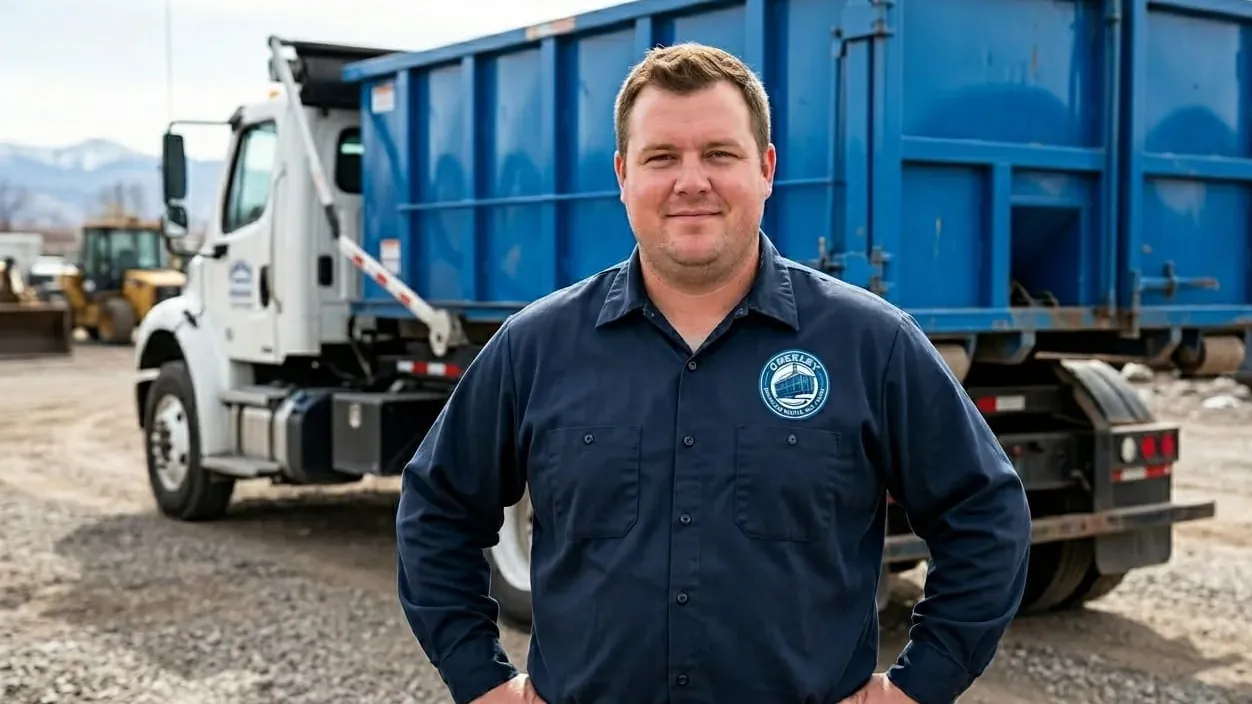
The question we are asked more than any other, and asked most nervously, is some version of: is this going to wreck my driveway?
It is a fair question and it deserves a straight answer rather than a reassuring one. A roll-off container is heavy before anything goes in it, the truck that carries it is heavier still, and the loading method involves the box rolling and dragging across whatever surface it lands on. The risk is real, it is manageable, and the way it is managed is boring and physical: something goes down between the steel and the concrete.
This article explains what actually happens during a delivery, what we put under the container, why Greeley’s particular mix of old concrete, dry ground and sudden weather changes the calculation, and how to choose the placement before the truck is on its way rather than after.
What a delivery physically does to a surface
A roll-off is not lowered onto your driveway. It is rolled off the back of a tilted truck bed, which is where the name comes from. Three things happen in sequence, and each has its own effect on the surface.
First, the truck drives in. A loaded roll-off truck is a heavy commercial vehicle putting its weight through a small number of contact patches. Most residential driveways were never designed with a heavy truck in mind, and the truck is often the largest single load the slab has ever carried.
Second, the bed tilts and the rear rollers touch down. For a moment, a large share of the container’s weight passes through two small steel wheels. That is the highest point pressure in the whole operation, and it is the moment that leaves marks on soft asphalt or scores a thin slab.
Third, the box drags. As the container settles, its rails slide across the surface for a few feet. Steel rails on concrete leave rub marks; steel rails on asphalt in July leave more than marks.
Pickup reverses the sequence, with the added complication that the container is now full and considerably heavier than it was going down.
The whole discipline of driveway protection is about spreading and separating those three moments.
What we put down
The standard answer, and it works: sheets of plywood or OSB under the wheels, and boards under the rails where the box will sit. Thicker is better; a single thin sheet flexes and telegraphs the load straight through. Two layers of substantial sheet material spreads the point load over square feet instead of square inches.
On an asphalt driveway in hot weather, the protection matters more, not less. Asphalt is a flexible pavement that softens as it warms, and a steel wheel parked on warm asphalt for four days will leave a depression that does not come back out.
Two practical notes worth knowing before delivery day:
- Tell us the surface when you book — concrete, asphalt, gravel, pavers, turf. It changes what we bring and where we suggest putting the box.
- Tell us if the driveway is old or cracked. We would far rather hear it on the phone than discover it under the wheels. An existing crack is a plane the slab has already chosen to fail along.
Greeley’s driveways are older than most, and that is the local point
Here is the part that is specific to this city rather than generic advice.
Greeley’s median home was built in 1985. Roughly 46 percent of the housing predates 1980, about 17 percent was built before 1960, and 7.2 percent dates from 1939 or earlier. Nearly 29 percent of the entire stock went up between 1960 and 1979.
Driveways come with houses. A driveway poured in 1968 has had fifty-odd winters of freeze and thaw, has probably been patched, and was poured to expectations that were not the current ones. In the older half of Greeley you find thinner slabs, narrow drives sized for a narrower car, and control joints that have long since become cracks.
Contrast that with a subdivision built after 2000, where the drives are new, wide and thick. The same container, delivered by the same truck, is a materially different proposition on a 1968 driveway than on a 2015 one — and in Greeley the 1968 driveway is the more common case, not the exception.
This is also why we will sometimes suggest a different placement. If we look at a narrow, cracked, mature driveway with a mature street tree overhanging it and say the street or the yard would be better, that is not us being awkward.
Ground conditions: dry most of the time, and then not
Greeley receives 15.34 inches of precipitation in an average year, measured at the Greeley–Weld County Airport station in NOAA’s 1991–2020 climate normals. That is Greeley’s own number, from Greeley’s own station, and it is dry — roughly a third of what a Southeastern city gets.
Most of the year, that works in your favor. Ground here is firm, and a container on gravel or on a compacted surface behaves itself.
The risk is not the average; it is the exception. The characteristic Colorado water event is a cloudburst that delivers a large share of a season’s rain in a couple of days. Northern Colorado saw exactly that in September 2013, and Greeley itself saw the Cache la Poudre come over its banks in June 2014. After rain like that, ground that has been firm for two months turns soft in an afternoon, and a loaded container on soft ground sinks, ruts and sometimes cannot be reached by the truck at all.
So the honest rule is: a container placed on unpaved ground is fine until the weather says otherwise, and the weather here does not warn you gently. If a storm is coming and the box is on turf or dirt, call us and let us move it or pull it early.
Freeze, thaw and the spring soft spell
The code the City has adopted specifies a frost line depth of 30 inches for Greeley — Table R301.2(1) in the residential code at Municipal Code § 22-76. That is a real winter, and it means the ground here freezes hard and thaws in stages.
Frozen ground carries weight well. The problem is the transition. In late winter and early spring the surface thaws while the ground below is still frozen, water has nowhere to drain, and a yard that carried a truck in January will not carry one in March. Greeley’s average last spring frost is 12 May, which is later than most people expect, and the weeks before it are the least reliable ground of the year.
Choosing the spot: four options, in order
1. The driveway
Usually the right answer. Hard surface, close to the work, entirely on your property, no permit in play. Protect it as above, and think about what else the driveway needs to do for the next week — a 20-yard container occupies most of a standard two-car drive.
2. The street
Sometimes better, and in Greeley it is permitted rather than prohibited — which is good news, because it means there is an actual answer. The City’s own permitting guidance names dumpsters directly: “Placement of dumpsters within the Public Space and roadways requires Public Space Traffic permits and proper signage.”
That permit comes from Public Works Permits, 970-350-9881, at 2835 W. 10th Street, Monday to Friday 7 a.m. to 4 p.m. Note the signage requirement, which people miss — a container in the roadway is a traffic control matter, not just a parking one. Our permit guide walks through it.
One thing not to rely on. Greeley Municipal Code § 12-269(a) permits trash containers on the public right-of-way for one 24-hour period in seven days. That is the weekly curbside rule for a household cart. It is not a 24-hour free pass for a roll-off, and it should not be read as one.
3. The yard
Works, with the ground caveats above, and with three things to check first: irrigation lines and sprinkler heads, which sit shallow in an irrigated city and do not survive a container; the route in, because the truck has to reach the spot and turn; and drainage, because the low corner of a yard is exactly where you do not want ten tons after a storm.
In unincorporated Weld County, add one more: never place a container over a septic tank or a leach field. A drain field is not built to carry concentrated weight and the damage is expensive and invisible until it is not.
4. The alley
Greeley’s older neighborhoods have alleys, and they can be a good answer for a back-of-house job. They are also the tightest access on any property, they are shared, and they still need to be passable for everyone else’s trash collection. Tell us if the alley is the plan so we can check whether the truck fits.
Clearances the truck actually needs
Three constraints stop more deliveries than soft ground does.
- Overhead. The truck raises the bed well above the height of the container to set it and to pick it up. Mature street trees, low branches, the service drop to the house, a basketball hoop and a garage door header are the usual culprits. Greeley’s older neighborhoods have handsome, mature trees, and handsome, mature trees are low.
- Width and turning. The truck needs room to line up straight with the drop point. A narrow drive with a gatepost at the entrance or a car parked opposite can make an otherwise fine placement impossible.
- Straight-line approach. A container is set backing straight in. It cannot be curled into position around a corner.
Greeley helps here in one respect: this is flat river-valley and high plains ground, laid out on a legible grid of numbered streets running east to west and numbered avenues running north to south, with lettered streets north of downtown. It is not foothill terrain, so steep approaches are rarely the problem. Tell us the nearest cross street and avenue and we will usually know the block.
The one placement rule that is not ours to waive
Five feet from a combustible wall. The City adopted the 2021 International Fire Code at Municipal Code § 22-454, effective 1 January 2023, and made no amendment to Section 304. Under Section 304.3, a dumpster must not be stored inside a building or placed within five feet of a combustible wall. Every roll-off we place is far over the size threshold in that section, so the rule applies to all of them, every time.
That sometimes conflicts with the tightest, most convenient spot on a narrow older lot. Where it does, the five feet wins. Questions about a specific placement go to the Greeley Fire Prevention Bureau, (970) 350-9510. Outside the city limits, in unincorporated Weld County, the county adopts no fire code and the question goes to the local fire protection district instead.
A short checklist for the day before
- Clear the spot and the approach — cars, bins, bikes, planters, the basketball hoop.
- Mark it if the exact position matters. A cone, a stake, a chalk line. We will follow it.
- Say the surface out loud when you book: concrete, asphalt, gravel, pavers, grass.
- Flag anything shallow underneath — sprinkler heads, a shallow line, a septic field, a window well, a cistern lid.
- Look up. Branches and the service drop.
- If it is going in the street, sort the City permit and the signage first, on 970-350-9881.
- Watch the forecast if the box is going on unpaved ground.
What we will and will not promise
We will protect the surface, and we will tell you honestly when we think a placement is a bad idea. That is the part we control.
We will not promise that a fifty-year-old slab with existing cracks comes through a heavy delivery unchanged. Nobody can promise that. Old concrete fails along the cracks it already has, and no amount of plywood changes what the slab is. If your driveway is at that stage, the street or the yard is very often the better call, and that decision is best made before the truck is loaded.
And we will not tell you anything about the ground under your particular address. Site-specific ground conditions are a matter for a geotechnical investigation, not for a web page. What we deal in is the surface: is it hard, is it soft, is it old, and is it wet.
Call (970) 888-6911 and describe the driveway before you book. It is a two-minute conversation that prevents the expensive kind of surprise. See also the sizing guide, residential containers, and who to call for what. The City’s own site is greeleyco.gov.
Questions this guide did not answer? Call (970) 888-6911. We would rather spend two minutes on the phone than have you order the wrong container.