
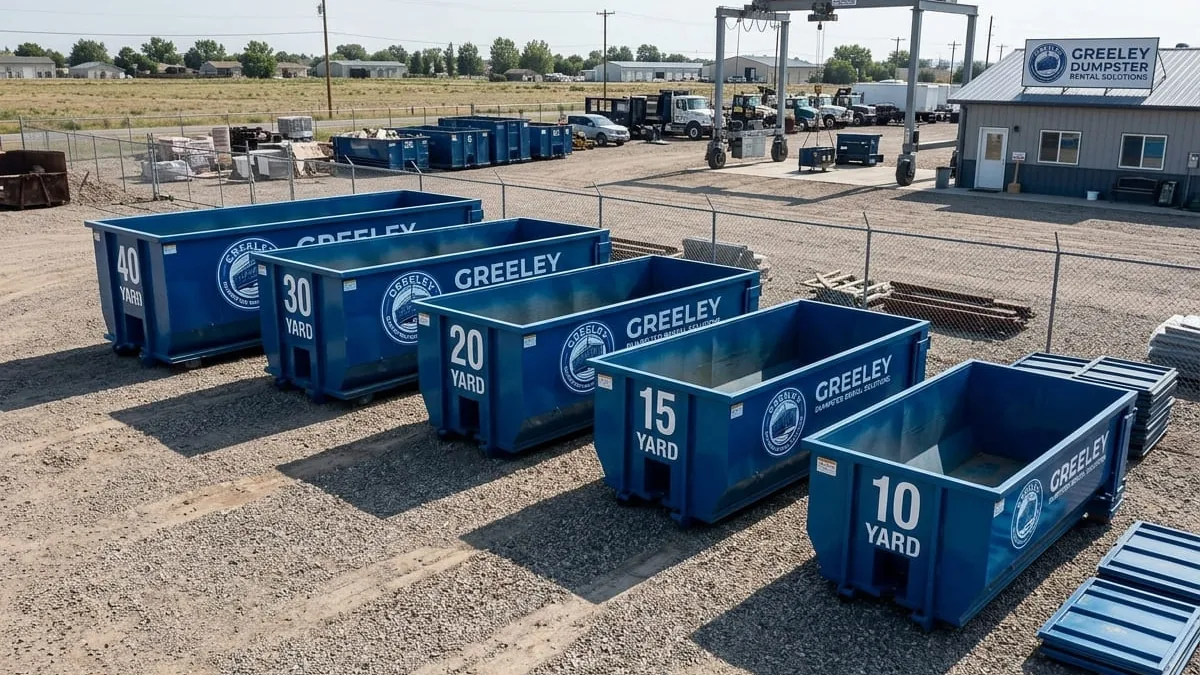
Compare all five sizes
Dumpster Sizes in Greeley, CO — 10, 15, 20, 30 & 40 Yard
Five boxes, and a straight answer about which of them the job wants. Two things settle it in this city, and neither of them is how big the pile looks. The first is what the debris weighs: masonry rubble, spoil out of a 30-inch footing trench, and a hail tear-off measured in squares and layers all come in far heavier than they read. The second is what the box will be standing on, because a soft gravel approach, a rear alley or a long pull down to a walkout will decide the placement long before volume gets a say.
All sizes
Pick by weight first, volume second
Scroll the table sideways on a phone. Any load carrying concrete, block, brick, mortar, footing spoil, tile bedded in mortar or shingle off a hail-struck roof should start at the 10 or the 15 whatever the job looks like from the yard, because weight fills those boxes before volume gets near them. A sizing chart written for somewhere else will miss three things about Greeley. First, the job that pays for the containers. Northeastern Colorado runs seven to nine hail days a year inside the corridor NOAA ranks most hail-prone in the country, which makes roof tear-off the reason this market rents boxes — and shingle is dense enough to reach lawful payload with the container looking part used, which is why a 30 or a 40 is never the roofing answer here. In a city whose median house dates from 1985 there is frequently a second course still nailed to the deck, doubling the tonnage again. Second, the ground and what was built into it. The residential code the City adopted publishes a 30-inch frost line, so footings and services begin deeper, trenches throw off more spoil, and houses were built with a floor underneath them — which makes the standard residential job a lower level and a garage emptied in the same fortnight rather than a single room. That is a volume job, and it is why the 20 yard goes out of this yard more often than the other four combined. Third, what the box is allowed to sit on. Several tons on four small pads will press into soft ground and then stay in the impression, so it is concrete rather than turf, with mats under the wheels and both rails on every single drop. And one jurisdictional note that settles more arguments than sizing ever will: a container standing in a Greeley roadway needs a Public Space traffic permit and proper signage, and a container standing on your own driveway needs none of it. Give us the address and we will tell you which of those you are.
| Size | Capacity | Box size | Tonnage included | Holds | Suits |
|---|---|---|---|---|---|
| 10 Yard Dumpster | 10 yd³ | 12 x 8 x 3.5 feet | 2 to 3 tons | around 3 pickup loads | Slab, block, brick and footing spoil — it reaches payload with the box still half empty. |
| 15 Yard Dumpster | 15 yd³ | 16 x 8 x 4 feet | 2 to 3 tons | around 4 to 5 pickup loads | One single-layer hail tear-off, or one room of an older house taken back to the studs. |
| 20 Yard Dumpster | 20 yd³ | 22 x 8 x 4.5 feet | 3 to 4 tons | around 6 to 8 pickup loads | The box that leaves our yard most: a basement and a garage cleared in one fortnight. |
| 30 Yard Dumpster | 30 yd³ | 22 x 8 x 6 feet | 4 to 5 tons | around 9 to 12 pickup loads | A whole-floor remodel, a lifetime of storage, or a May turnover. Shingle never rides in it. |
| 40 Yard Dumpster | 40 yd³ | 22 x 8 x 8 feet | 5 to 6 tons | around 12 to 16 pickup loads | Bulk with no weight in it — and it wants more room to land than anything else we run. |
10 Yard Dumpster
Slab, block, brick and footing spoil — it reaches payload with the box still half empty.
View this size → 15yd³15 Yard Dumpster
One single-layer hail tear-off, or one room of an older house taken back to the studs.
View this size → 20yd³20 Yard Dumpster
The box that leaves our yard most: a basement and a garage cleared in one fortnight.
View this size → 30yd³30 Yard Dumpster
A whole-floor remodel, a lifetime of storage, or a May turnover. Shingle never rides in it.
View this size → 40yd³40 Yard Dumpster
Bulk with no weight in it — and it wants more room to land than anything else we run.
View this size →Two rules, in this order
Dense debris runs out of tonnage before it runs out of room — and the surface outranks both
If you read one paragraph on this page, read this one. Every container has two ceilings: the room inside it, and the weight a truck may lawfully lift and carry away. Bulky light debris hits the first ceiling. Dense material hits the second — and it hits it a great deal sooner than anybody expects it to.
The dense material in this market is masonry rubble, tile bedded in mortar, trench spoil and shingle. Concrete and block run somewhere between 2,400 and 2,800 lbs a cubic yard — a figure off our own scale tickets rather than a published table, and the argument survives whatever the true number is. A front walk, a patio, a section of basement floor or an old block wall will reach lawful transport weight in a can that still looks part used. Dug ground is what people here misjudge most, and the frost line explains why: the residential code the City adopted specifies 30 inches, so a footing, a lateral or a water service trench starts deeper than a customer imagines and yields correspondingly more spoil, which neither settles nor compresses. Where roughly 46 percent of the housing is older than 1980, replacing a sewer line and repairing a foundation are recurring work rather than rarities. Then the roof, which in this city is the headline act. It is counted in squares and layers and never by area, and on a sixties or seventies ranch a second course is frequently still on the deck, doubling the tonnage on a job that read as one can. Water is not the weight risk here that it is elsewhere — the 1991–2020 normal at Greeley–Weld County Airport comes to 15.34 inches a year — but it arrives in bursts, and one cloudburst will put real tonnage into an open box across an afternoon. Sorting still pays, and for a particularly Colorado reason: no statewide schedule exists of what a landfill has to refuse. Past the electronics ban and the tire rules, every facility fixes its own accepted and prohibited lists inside an approved operating plan, and the site itself runs on a certificate of designation the county grants under C.R.S. § 30-20-102. Two things leave every load without discussion: electronics, out of Colorado landfills since 1 July 2013 under C.R.S. § 25-17-303, and tires, refused at the gate. Brush stays separate too — not for legal reasons, since this state has never banned yard waste from a landfill and the gates serving the county list branches among what they take, but because the composting route is nearer and cheaper: the City’s GROW Center on 970-673-3718 for grass, leaves, plants, limbs, branches and untreated lumber, and A-1 Organics at Eaton on 970-454-3492.
The second rule never appears in a sizing chart written for another state. What the box stands on matters as much as which box it is. What the ground does at depth under your slab is not something we will publish — that needs a geotechnical investigation, nobody has surveyed your driveway, and anybody answering it off a website is guessing. The Colorado Geological Survey does map a potentially swelling-clay corridor along the Front Range with Greeley at its northern end, noting that clays of that kind can take on up to twenty percent by volume once wet — which is a reason to keep a heavy box on concrete, not a statement about your address. The surface is the part we work with, and it runs to three moods. Dry, it carries a loaded container as well as ground anywhere in the country. Soft — after an irrigation set, after snowmelt, after a cloudburst — and several tons on four small pads will cut into turf or an unpaved verge and stay in the cut. Frozen, it holds until the thaw. So: concrete, not grass, and mats under every wheel and both rails, on every drop, twelve months of the year. Wind belongs in the same paragraph, because Weld County publishes a 115 mph basic residential wind speed and recorded Front Range chinook gusts have reached 137 mph. An open box of light material is a sail. There is a placement number attached to all of this, and for once it is a real one rather than something off a national blog: Greeley adopted the 2021 International Fire Code at § 22-454 with effect from 1 January 2023 and left Section 304 unamended, so under Section 304.3 a dumpster must not be stored inside a building or placed within five feet of a combustible wall. Every roll-off we run is far over the threshold in that section, which makes the answer stable: five feet, on all of them. The same section carries the 40-gallon lid rule and the requirement that oily rags and anything else liable to spontaneous ignition go in a listed disposal container instead of loose in a box. Placement questions belong with the Greeley Fire Prevention Bureau on (970) 350-9510; the City runs seven fire stations of its own. The loading rule that holds it all together is short: flat and low, heavy underneath, nothing standing proud of the rail. Anything proud of the rail cannot be covered, and it will not be collected until it is leveled. The 30 and the 40 yard earn their keep on bulk carrying no weight — a shed, deck or outbuilding coming down, a whole-house clearance, a lower level and garage emptied after thirty years — with room to work around them. Take the scrap metal and the flattened cardboard out before we arrive, and take the electronics out because this state will not permit them into a landfill at all.
Describe the material, roughly how much of it there is, and what the driveway looks like. We will size it properly, and we have every incentive to, because getting it wrong costs this company more than it costs you.
How it works
Phone call to empty driveway
- 1
Tell us the job
Two minutes, and a cross street and an avenue is enough to place you on this grid. You hang up with a flat number that has the disposal inside it.
- 2
We set it down
The driver walks the approach first, puts mats under both rails, and keeps the box the five feet clear of combustible wall that Section 304.3 asks for.
- 3
Fill it flat and low
Use the days in your window. Heavy on the bottom, nothing standing proud of the rail, and tarped — wind is the risk here, not rain.
- 4
Say the word
Ring or text and we pull it. Metal, cardboard and electronics come out on the way, and the rest goes to a gate permitted to take it.
Choosing a Size — FAQs
Which dumpster size is most popular in Greeley?
The 20 yard, and not narrowly. It takes a lower level and a garage emptied in one fortnight, a kitchen gut, or a remodel running through several rooms, and it still fits an ordinary driveway in this city. That is a Greeley answer rather than a generic one, because the residential code adopted here publishes a 30-inch frost line: basements are normal, the standard residential job has a downstairs inside it, and that makes it a volume job instead of a weight job. Next most common is the 15 yard, which is arguably the box this market actually runs on — right for a single-layer hail tear-off on an average house, right for one room taken to the walls, right for a turnover, and with 39.1 percent of households renting, turnovers never stop. Anything carrying concrete, block, brick, mortar or trench spoil travels the other direction, down to a 10 yard. A roof never travels upward at all: shingle makes lawful payload well before it fills a 30.
What size do I need for a roof tear-off?
On a Greeley house it is a 15 yard for a single-layer tear-off and a 20 the moment a second layer or the decking is involved. Roofing does not go in a 30 or a 40 here, ever. The job is weight-driven rather than volume-driven, so it is squares and layers that decide it and never the area of the roof — and with a median year built of 1985 and roughly 46 percent of the housing older than 1980, a second course still on the deck is ordinary rather than exceptional. This is the anchor job in this market. Northeastern Colorado runs seven to nine hail days a year inside the corridor NOAA ranks most hail-prone in the country, one storm can push a whole neighborhood of roofs into replacement at the same moment, and the fortnight afterwards is the fortnight to have booked already. Who deals with the debris is straightforward here, because there is nobody to hand it to: under § 8-371 the City is “the sole agency for the collection and disposal of refuse” acting through “city-licensed operators,” so there is no municipal truck, and the City’s own Spring Clean-Up refuses construction and demolition debris outright. There is also a placement number worth planning around: Greeley adopted the 2021 International Fire Code at § 22-454 and makes no amendment to Section 304, so under Section 304.3 a dumpster must not be stored inside a building or placed within five feet of a combustible wall — and on a tear-off that matters, because directly against the house is exactly where you want the box. Old felt, mastic and cement-asbestos shingle can all contain asbestos, and that halts the job until somebody has surveyed it. Colorado treats it as air quality under CDPHE Regulation 8, Part B — triggered on a single-family house at 32 square feet or 50 linear feet, with a certified inspection ahead of the work and ten working days of notice, on 720-507-5136. The arithmetic in full is in our hail tear-off guide.
Is the 40 yard just the biggest and best?
No, and assuming so is an expensive assumption. The 40 is a volume box for bulky light debris: framing, cabinetry, decking, packaging, a house emptied wholesale. Put dense material in it and lawful transport weight arrives long before the box is full, and a tear-off should not go anywhere near one. It also wants more room than anything else we run, which rules it out along plenty of the older streets downtown and around Monroe Avenue, where lots are narrow, drives are short and most of the container work happens off the rear alley — and on any lot where the only level ground is unpaved. A big open box of light material has to sit below the rails and be covered, because with a 115 mph design wind on the books and recorded chinook gusts of 137 mph, the wind will distribute the rest of it along the street for you. Where room is tight we generally run two smaller boxes through instead, and it works out better for everybody involved.
Can I change size after I book?
Yes, right up until the truck leaves. And if the job you describe does not match the box you have asked for, you will hear about it before delivery rather than afterwards. A change made on the phone costs nothing at all; the same discovery made at the scale house costs a good deal.
How much space do I need?
The footprint of the box plus room to work around it: roughly 60 feet of straight approach for the truck, about eleven feet of width, and 20 feet or more of clear air while the hoist is up. Surface counts for as much as space in this city. Say whether the spot is concrete, asphalt, gravel or turf, and whether it stays soft for a day after an irrigation set, snowmelt or a cloudburst — soft ground will not carry a loaded box, and a dry drive will. On fire code Greeley hands you a number instead of a rule of thumb: it adopted the 2021 International Fire Code at § 22-454, effective 1 January 2023, and makes no amendment to Section 304, so under Section 304.3 a dumpster must not be stored inside a building or placed within five feet of a combustible wall. That holds on a private driveway and not merely on a job site, and every roll-off we run sits far over the threshold in that section. Should any part of the box come to rest in the roadway or the Public Space, the City has published the answer itself: “placement of dumpsters within the Public Space and roadways requires Public Space Traffic permits and proper signage” — that is Public Works Permits on 970-350-9881, 2835 W. 10th Street. Outside the city limits it is Weld County at 1150 O Street, (970) 400-4000, or the separate town’s own counter. And look upward before you settle on a spot, because a mature limb, a porch roof, a low gutter or the service drop into the house will stop the arm dead.
Services
What people put in them
Residential Dumpster Rental
Basements, garages and thirty years of storage out of a house that predates 1980.
Learn more →Commercial Dumpster Rental
Shops, restaurants and contractors inside the limits, where the City is the permit desk.
Learn more →Construction Dumpster Rental
Mixed C&D in one box, swapped next day anywhere the county seat reaches.
Learn more →Roofing Dumpster Rental
Counted in squares and layers, because hail is the job this county buys containers for.
Learn more →Roll-Off Dumpster Rental
Ten through forty yard boxes, out of the yard on 14th Avenue every working day.
Learn more →Same-Day Dumpster Rental
Ring before nine and there is usually an afternoon slot still on the board.
Learn more →Talk to a real person
Not sure which size you need?
Describe the load — the room, the roof, the basement, the slab out the back — and you will get the size, the flat number and the day, on the phone, first time of asking. There is nothing on this site to fill in and nothing sitting in an inbox overnight.
Greeley and every one of the seventeen places we run to in Weld County · Mon–Fri 6:30am–5pm, Sat 7am–1pm