
Sizing Guide
Hail, Roof Tear-Offs and Dumpster Sizing in Greeley
Seven to nine hail days a year, and a housing stock where half the roofs are on their third covering. Roofing fills a container by weight long before volume, which is why the answer is a 15 or a 20 and never a 30.
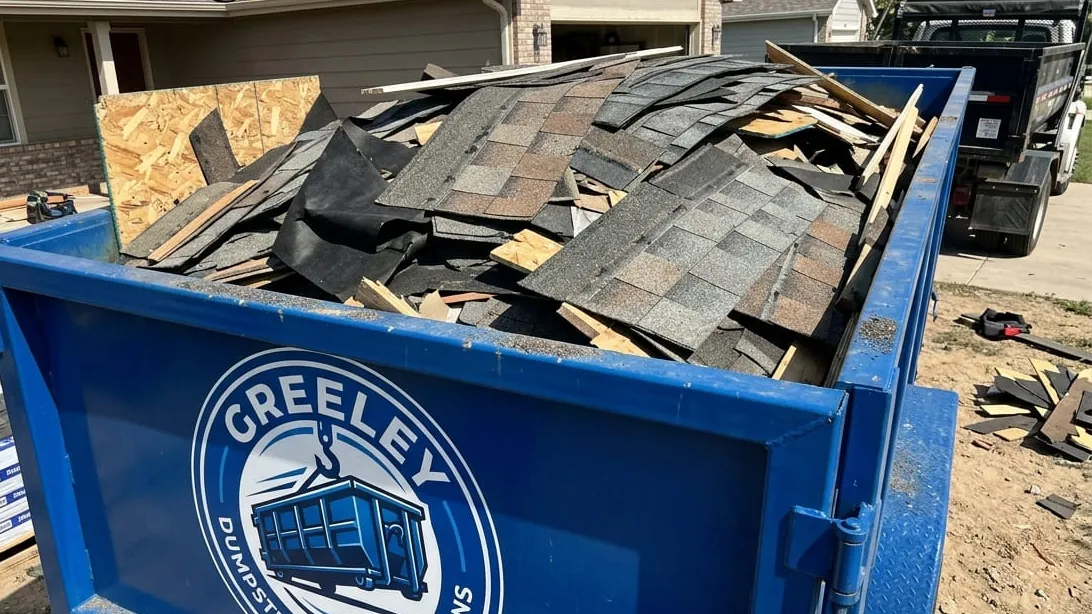
Greeley sits in the middle of the most hail-prone corridor in the United States. That is not a marketing line; it is what the climate record says about northeastern Colorado, which averages seven to nine hail days a year. Colorado ranked sixth nationally with 244 large-hail events in 2025, according to the Insurance Information Institute citing NOAA’s Storm Prediction Center. A single Denver hailstorm in May 2017 caused insured losses of more than $2 billion.
So roof work here is not a rare event that follows a rare storm. It is a recurring seasonal industry, and every tear-off produces one of the heaviest, most awkward, most frequently mis-sized loads in this business.
This article is about the sizing, because sizing is where roofing jobs go wrong, and about the specific things that make a Greeley tear-off different from one in a newer town down the road.
The rule that governs everything: roofing fills by weight, not by volume
Start here, because everything else follows from it.
Asphalt shingle is dense. Layered, nailed, saturated with years of grit and sometimes still wet from the storm that caused the job, it is one of the heaviest materials that goes into a container on a residential street. A roofing load reaches its lawful payload long before it reaches the top of the box.
Which produces the single most important sentence on this page:
Roofing never goes in a 30-yard or a 40-yard container.
Not because we do not have them, and not because they would not physically hold the shingle. Because a 30 or a 40 filled with tear-off is a truck that cannot legally leave your driveway. The extra capacity is capacity you are never allowed to use, and the only thing a big box on a roofing job reliably produces is a partially full container that nobody can move.
What size you actually need
- A 15-yard container is the working answer for an ordinary single-layer house tear-off. One covering, coming off a typical Greeley single-family roof, and the 15 is right.
- A 20-yard container is the answer for a large roof, for two layers, or where decking is coming off with the shingle. Plywood or board decking adds real bulk on top of the weight.
- Beyond that, the answer is a second pull, never a bigger box. We take the full one, bring an empty one, and the job carries on. Two trips with a right-sized container is the normal, lawful way to handle a big roof. It is not a failure of planning; it is the plan.
If you are not sure which side of the line you are on, tell us the footprint of the house, whether the roof is a simple gable or cut up with dormers and valleys, and — the question that matters most in this city — how many layers are up there.
Why Greeley in particular runs to multiple layers
Here is where the local numbers change the answer.
Greeley’s median home was built in 1985. About 46 percent of the city’s housing predates 1980, and nearly 29 percent of it went up between 1960 and 1979. A house built in 1968 has had somewhere between forty and sixty years of roofing decisions made about it by a succession of owners, and in a hail corridor those decisions came around often.
That means a meaningful share of Greeley roofs are on their second, third or fourth covering. Somewhere in that history, at least one crew went over the top rather than tearing off — which was normal practice for a long time and is why the layers are there.
Two layers is not twice the fuss. It is twice the weight in the same volume, which is exactly the axis that constrains a roofing container. A crew that has been sizing boxes in a subdivision built after 2000, where nearly every roof is on its first or second covering, will under-size a Greeley job. This is the clearest example on the whole site of the difference between an old city and a new one.
Find out how many layers before you order the container. A roofer can tell you from the eave in thirty seconds, and it changes the answer.
The other things that go in the box — and one that does not
A tear-off is rarely only shingle. Budget for:
- Felt and underlayment, which comes off in heavy, awkward sheets
- Flashing, drip edge, vents and pipe boots — metal, light, but it takes room
- Rotten decking, which you will not know about until the shingle is off
- Ridge caps, ice barrier and sometimes an old wood shake layer hiding underneath everything else
- Gutters and downspouts, if the hail took them too, which it usually did
And the thing that does not go in: solvent-soaked rags, roofing cement rags and oily wipes. That is not fussiness — it is a fire rule. Greeley adopted the 2021 International Fire Code at Greeley Municipal Code § 22-454, effective 1 January 2023, with no amendment to Section 304, and Section 304.3 requires materials susceptible to spontaneous ignition, such as oily rags, to be kept in a listed disposal container. Spontaneous ignition in a pile of rags is a real and well-documented cause of job-site fires. Keep them out of the roll-off and out of the pile beside it.
Paint, solvent, sealant and thinner in liquid form go to Weld County’s household hazardous waste facility, 1311 North 17th Avenue, Greeley, (970) 400-2217, Tuesday, Thursday and Saturday 8 a.m. to 5 p.m., free to every Weld County resident. The published limits are 200 pounds per household per visit, nothing over five gallons, no leaking containers and no plastic bags.
The five-foot rule, and why roofers hit it more than anyone
The instinct on a roofing job is to park the container as close to the wall as possible so the shingle drops straight off the edge into the box. That instinct runs directly into the fire code.
Under Section 304.3 of the fire code Greeley has adopted, a dumpster must not be stored inside a building or placed within five feet of a combustible wall. Every roll-off container we place is far over the size threshold that section sets, so the five-foot rule applies to all of them. There is no small-container exception to reach for.
In practice that means the box goes five feet out, and the crew tarps and shovels the gap. Questions about a particular placement go to the Greeley Fire Prevention Bureau on (970) 350-9510, which is a City department — Greeley runs its own fire department, with seven stations, and it enforces the code the City itself adopted.
Outside the Greeley city limits the answer changes. In unincorporated Weld County the county adopts no fire code of its own; the International Fire Code applies only where a local fire protection district has adopted it. So for an address in Lucerne, Galeton or Gill, that question goes to the fire district, not to the county. See who do I actually call.
Wind, and why a roofing load gets tarped
Two independent local reasons to cover a loaded container, and both are documented.
The wind here is serious. Front Range downslope windstorms are a recognized hazard: in January 1982 a chinook event recorded gusts of 137 mph at NCAR’s Table Mesa site and 140 mph at Wondervu, and northern Colorado took its worst of that storm on 24 January. Weld County’s published residential design wind is a 115 mph three-second gust. Loose felt, torn underlayment and shingle fragments do not stay in an open box in that.
And the gate rules are unforgiving. One of the landfills serving this region publishes that all incoming loads are subject to random inspection and that all uncovered or unsecured loads will be charged double. An untarped roofing load is expensive twice: once on the road and once at the scale.
Load level, keep the material below the rails, and cover it. Every time.
Timing a hail job in Greeley
Hail season on the Front Range runs through spring and summer, and it does not send appointment letters. Two practical consequences.
After a significant storm, demand arrives all at once. Every roofer in the county is on the same streets in the same fortnight, and every one of them needs a container. Booking a day ahead in ordinary weather is fine. Booking a day ahead in the week after a hailstorm is optimistic.
And there is a separate seasonal squeeze in early May that has nothing to do with hail. Greeley’s average last spring frost is 12 May, so outdoor work of every kind starts then; the university year ends and a large renter population turns over; and the City runs its two-day Annual Spring Clean-Up in the same fortnight. If your roof job lands in that window, book earlier than you think you need to. The Spring Clean-Up guide explains that event and what it refuses.
One sequencing note: whatever your insurance process requires in the way of inspection and documentation, get it done before the tear-off. Once the covering is in the box, it is no longer on the roof, and no one can look at it there.
Where the container goes on a roofing job
Roofing containers sit for days, get loaded from height, and take a beating. Placement matters more than on almost any other job.
- The driveway is usually right — close to the work, on a hard surface, off the street entirely. But Greeley’s older half has older driveways, and a heavy tear-off load on a thin 1960s slab is worth planning for. We put plywood under the wheels and boards under the rails. The driveway protection guide covers it properly.
- The street needs a City permit. Greeley’s own permitting guidance is explicit: “Placement of dumpsters within the Public Space and roadways requires Public Space Traffic permits and proper signage.” Public Works Permits, 970-350-9881, 2835 W. 10th Street, Monday to Friday 7 a.m. to 4 p.m. See the permit guide.
- Not on the lawn unless there is genuinely no alternative, and not after rain. Greeley gets only 15.34 inches of precipitation a year, measured at Greeley–Weld County Airport, so the ground is usually firm — but irrigated turf over soft ground and a loaded roofing box is how ruts happen.
- Watch the overhead. A roll-off truck has to raise the box to set it and again to take it. Mature street trees in Greeley’s older neighborhoods and the service drop to the house are the two things that stop a delivery.
Cleaning up afterward, which is half the job
Two things a roofing crew leaves behind that a container does not solve on its own.
Nails. A tear-off scatters thousands of them across the lawn, the drive and the flowerbeds. A rolling magnet over every surface, more than once, in more than one direction, is the only method that works. Do it before the container leaves, not after.
Granules and fragments in the gutters and the landscaping. Shingle grit ends up in gutter runs, window wells and gravel beds, and it does not wash away.
And the code has a view about the leftovers. Greeley Municipal Code § 12-269(b) requires that refuse and debris left by the demolition or repair of a building be removed following substantial completion of the work. A stack of old shingle beside the driveway three weeks after the roofers left is a code problem, not just an eyesore.
The short version
- 15 for an ordinary single-layer house tear-off.
- 20 for a large roof, two layers, or decking coming off.
- Never a 30 or a 40. Beyond a 20, the answer is a second pull.
- Count the layers before you order. In a city where nearly half the housing predates 1980, that is the question that decides the size.
- Five feet from a combustible wall, always. Fire Prevention: (970) 350-9510.
- Tarp it. 115 mph design wind, and uncovered loads get charged double at the gate.
- Oily and solvent rags stay out of the box.
Call (970) 888-6911 with the address, the roof size and the number of layers, and we will tell you which container and how many pulls. More on roofing containers, on the 15 and the 20, and in the general sizing guide. The National Weather Service Denver/Boulder office is the forecast office that covers Weld County.
Questions this guide did not answer? Call (970) 888-6911. We would rather spend two minutes on the phone than have you order the wrong container.