
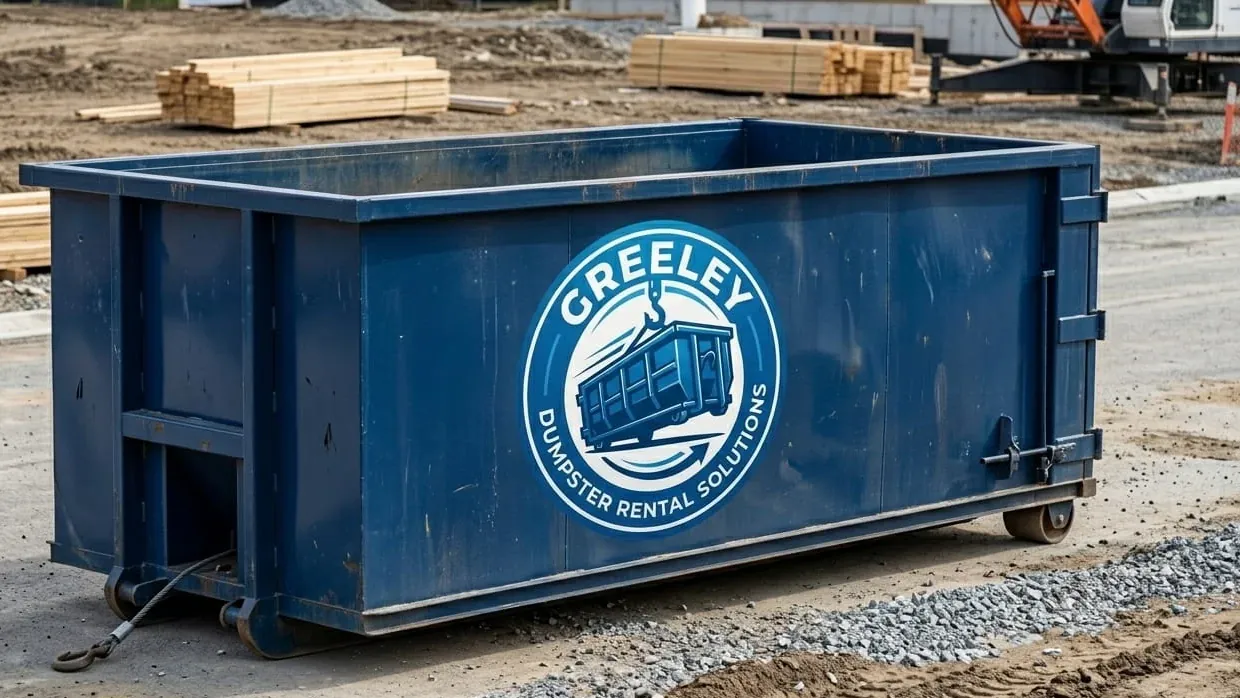
One bounded job
15 Yard Dumpster Rental in Greeley, CO
The container for a job with a clear edge on it — one bathroom, one kitchen, one bay of the basement, one ordinary single-layer roof. It is also the size that takes a heavy load better than most people expect.
A 15 yard roll-off runs about sixteen feet long, eight feet wide and roughly four feet tall — four to five pickup loads, with sides still low enough to load over on most of it. In Greeley it does two jobs: it is the roofing workhorse for an ordinary tear-off, and it is the right answer whenever a job has a definable edge on it. If your job has an edge you can describe in a single phrase, this is almost always the container for it.
- Capacity15 cubic yards
- Box size16 x 8 x 4 feet
- Tonnage included2 to 3 tons
- Holdsaround 4 to 5 pickup loads
Why people choose the 15 yard
The 15 is the roofing container in this market, and roofing is a bigger part of the Greeley year than of almost anywhere else. NOAA’s Colorado state climate summary puts northeastern Colorado at seven to nine hail days a year, inside what it calls the nation’s most hail-prone corridor, and the Insurance Information Institute, citing NOAA Storm Prediction Center data, ranked Colorado sixth in the country in 2025 with 244 large-hail events. An ordinary single-layer asphalt tear-off on a Greeley house fits a 15, and that is the answer more often than any other. Size a roof on squares and layers rather than on the footprint of the house: a square is a hundred square feet of roof surface, and pitch, hips, dormers and overhangs make the roof bigger than the plan area, frequently by a quarter or more.
Layers are where the sizing goes wrong, and Greeley’s housing makes that a live risk. The median home here was built in 1985 and roughly 46 percent of the stock predates 1980, so a great many roofs are on their second, third or fourth covering — and where an earlier crew roofed over instead of tearing off, the debris roughly doubles. Two layers of asphalt shingle is dense, non-compressible material that arrives in one afternoon and reaches a lawful road payload while the box still looks like it has room. If the roof is two layers, or large, or the decking is coming off with the covering, step up to a 20. What you do not do is step up to a 30 — roofing never goes in a 30 or a 40, and beyond a 20 the right answer is a booked second pull.
Away from roofs, the 15 is the container for a job with an edge on it. One bathroom. One kitchen. One bay of the basement. A single room stripped back to studs. A garage cleared out. A shed removed. Those jobs have a knowable volume, they are the ones most often sized correctly over the phone, and the 15 costs less than the 20 that people reflexively book. The test is simple: if you can describe the job in a single phrase without adding an and, it is probably a 15. If you find yourself adding rooms as you describe it — and in a Greeley house with a lower level that happens often — the honest answer is a 20.
The 15 also takes heavy material better than most people expect, which makes it the useful middle box on a mixed job. A patio removal with the pergola coming off, a footing dig with form material in it, a masonry demolition with some framing mixed through — all of those are too heavy for a 20 and too bulky for a 10. Load dense material as a flat layer across the whole floor rather than heaped in the middle, and keep clean streams clean: clean concrete, clean masonry and clean fill are their own accepted materials at the facilities serving Weld County, and a load with drywall and plastic through it is not.
Good fit for
- An ordinary single-layer roof tear-off on a house
- One bathroom or one kitchen stripped out
- A single room taken back to the studs
- A garage or a shed cleared out completely
- A bounded basement project, one bay at a time
- A patio, deck or fence removal of moderate size
- A mixed load with some masonry through it
- A small commercial tenant space reset
Not the right size for
- A whole-house declutter with a basement in it
- A house being emptied completely
- A two-layer tear-off or a roof with decking coming off
- Pure concrete, block or trench spoil, which want a 10
- A commercial build-out full of packaging and ceiling grid
- A yard full of storm debris after a wind event
Will it fit?
At about sixteen feet the 15 is comfortably a driveway container. On most Greeley lots it sits in front of a garage without blocking the walk, and on the older grid it goes down an alley approach easily, which is often the tidier placement. The truck wants roughly sixty feet of straight run, about eleven feet of working width and twenty feet of overhead clearance for the hoist, and the obstacle here is usually overhead rather than underfoot — service drops and mature limbs over the drop point get checked before anything else. Plywood goes under the wheels and the rear rollers as standard, and we would rather set the box on concrete or compacted base than on a lawn or a graded shoulder, especially after rain or in a spring thaw when ruts and soft ground are the damage that actually happens here. On a roofing job the box wants to be close to the work, but the clearance rule is fixed: five feet from any combustible wall under Section 304.3 of the 2021 International Fire Code, adopted by the City at § 22-454 with Section 304 unamended, so it goes five feet off the siding and clear of the eave even where a shorter throw would be easier. Placement questions go to Greeley Fire Prevention, (970) 350-9510. Two further points from the same section of the fire code, both of which come up on remodel and roofing work. Containers with a capacity over forty gallons are required to have lids, so loose combustible waste does not simply sit open against a building. And materials liable to spontaneous ignition — oily rags, sealant-soaked cloths, stain and finish waste — belong in a listed disposal container rather than loose in a roll-off. That is a real jobsite fire cause rather than a paper rule, and it costs nothing to get right.
Ahead of the truck: shift the cars and the carts, and where the property runs on its own system, mark the septic lid, the drain field and the well head. Then tell us about anything the driver cannot see from the street — concrete poured recently, made or filled ground, an irrigation line run shallow beside the drive, a street still on base course waiting for its top lift, a low service drop or a shade tree standing over the only flat spot. A loaded box puts several tons onto four small pads. Dry, this ground carries that without complaint; ground that has just taken an irrigation set, a cloudburst or a thaw will press and hold the impression — which is why it is concrete rather than turf, with mats under every wheel and both rails as standard. And the box comes to rest five feet off any combustible wall, opening or combustible eave line. That is Section 304.3 of the 2021 International Fire Code, adopted by the City of Greeley at § 22-454 with effect from 1 January 2023 and left unamended at Section 304. The section carries a capacity threshold that has never once mattered to us, because every roll-off is many times over it — so the answer is five feet on all five boxes, measured off the nearest combustible surface rather than the plane of the wall. On private property — a driveway, a yard, a parking lot — no Public Space permit is engaged at all, which covers close to everything we set. Where any part of the box has to stand in a Greeley street, alley or sidewalk, the City names dumpsters directly in its own permitting guidance: “placement of dumpsters within the Public Space and roadways requires Public Space Traffic permits and proper signage.” That desk is Greeley Public Works Permits, 970-350-9881, at 2835 W. 10th Street. Do not lean on § 12-269(a), which lets a trash container sit on the right-of-way for one 24-hour period in seven — that is the weekly curbside rule for a household cart and not a pass for a roll-off. Fire clearance questions belong to Greeley Fire Prevention, (970) 350-9510, and everything else city-side to Greeley 311, (970) 351-5311. Past the city limits the answers change and we will not pretend they do not: in one of the separate Weld County municipalities, ask that town, because no town’s container or right-of-way rules were established by the research behind this site; on unincorporated ground it is Weld County, 1150 O Street in Greeley, (970) 400-4000, whose right-of-way language reaches the occupation of a county right-of-way without ever naming a dumpster, which warrants a call rather than an assumption. And where your own project involves digging — a footing, a stump, fence posts, a sewer lateral — Colorado 811 comes first on 811 or 800-922-1987: notice is two business days under C.R.S. § 9-1.5-103 excluding the day it is given, Colorado 811 itself asks for three, and the dig area gets marked in white beforehand. Our delivery and driveway protection guide and the Greeley placement and permit guide cover the rest.
Compare all five sizes
| Size | Box size | Tonnage included | Holds | Suits |
|---|---|---|---|---|
| 10 Yard Dumpster | 12 x 8 x 3.5 feet | 2 to 3 tons | around 3 pickup loads | Slab, block, brick and footing spoil — it reaches payload with the box still half empty. |
| 15 Yard Dumpster | 16 x 8 x 4 feet | 2 to 3 tons | around 4 to 5 pickup loads | One single-layer hail tear-off, or one room of an older house taken back to the studs. |
| 20 Yard Dumpster | 22 x 8 x 4.5 feet | 3 to 4 tons | around 6 to 8 pickup loads | The box that leaves our yard most: a basement and a garage cleared in one fortnight. |
| 30 Yard Dumpster | 22 x 8 x 6 feet | 4 to 5 tons | around 9 to 12 pickup loads | A whole-floor remodel, a lifetime of storage, or a May turnover. Shingle never rides in it. |
| 40 Yard Dumpster | 22 x 8 x 8 feet | 5 to 6 tons | around 12 to 16 pickup loads | Bulk with no weight in it — and it wants more room to land than anything else we run. |
Still weighing it up? Describe the pile and it gets sized on the phone inside two minutes. We have every incentive to get that right, because a wrong box costs this company more than it costs you. Ring (970) 888-6911.
Put a 15 yard on the board
One figure covering the drop, the pull, your days on site and the disposal. Same-day when the schedule allows.
(970) 888-6911The other four
Often booked with it
All sizes
The five boxes side by side
10 Yard Dumpster
Slab, block, brick and footing spoil — it reaches payload with the box still half empty.
View this size → 15yd³15 Yard Dumpster
One single-layer hail tear-off, or one room of an older house taken back to the studs.
View this size → 20yd³20 Yard Dumpster
The box that leaves our yard most: a basement and a garage cleared in one fortnight.
View this size → 30yd³30 Yard Dumpster
A whole-floor remodel, a lifetime of storage, or a May turnover. Shingle never rides in it.
View this size → 40yd³40 Yard Dumpster
Bulk with no weight in it — and it wants more room to land than anything else we run.
View this size →15 Yard Dumpster FAQs
Is a 15 really enough for a roof?
For an ordinary single-layer asphalt tear-off on a Greeley house, yes, and it is the size we send to those jobs more than any other. The arithmetic that matters is squares and layers, not the size of the house. A square is a hundred square feet of roof surface — pitch, hips, dormers and overhangs make that larger than the floor area, often by a quarter. A second layer roughly doubles the debris, and on Greeley houses from the sixties and seventies a second layer is common, because roofing over was standard practice for years. So the three things to tell us are the square count, the number of layers, and whether the decking is coming off. If it is one layer on an ordinary roof, a 15. If it is two layers, a large roof, or decking coming off, a 20. Never a 30. Call (970) 888-6911.
How do I know if my job is a 15 or a 20?
Try to describe it in one phrase. If it comes out as a single bounded thing — the hall bathroom, the kitchen, the garage, one bay of the basement — it is a 15 and it will cost you less. If you find yourself adding an and, it is a 20. That test works particularly well in Greeley, because so many houses here have a lower level: the City’s own adopted residential code specifies a thirty-inch frost line, footings and services go that deep anyway, and full basements are ordinary as a result. So the standard whole-house job here is not a set of rooms, it is a lower level plus a garage plus a storage level, and that is a 20 every time. The commonest sizing mistake we hear on the phone is a 15 booked for a job that was always a 20.
Can I put concrete or dirt in a 15?
Yes, and the 15 handles a heavy load better than most people expect — it is the right box for a mixed job that has some masonry through it, like a patio removal with the structure coming off, or a footing dig with form material. What it will not take is a full load of dense material. Concrete, block, brick, tile in a mortar bed, sod, rock and trench spoil reach a lawful road payload well before they reach the rail, and a 15 filled with any of them cannot lawfully leave the driveway. Pure masonry and pure spoil belong in a 10 loaded flat. Keeping that material clean also keeps its routes open, because clean concrete and clean fill are separate accepted streams from mixed construction debris.
What cannot go in it?
Electronics first and hardest — banned from Colorado landfills since 1 July 2013 under C.R.S. § 25-17-303, so televisions, monitors, computers and printers all need their own route. Tires next, refused locally and routed to registered tire facilities under Colorado’s waste tire rules. Then liquids, paint, solvents, fuel, oil, pesticides, pool chemicals, pressurized tanks, batteries, hot ashes, refrigerant-containing appliances, and anything containing asbestos. There is a free local answer for the chemicals: Weld County Household Hazardous Waste, 1311 North 17th Avenue in Greeley, (970) 400-2217, Tuesday, Thursday and Saturday 8 a.m. to 5 p.m., open to every Weld County resident — 200 pounds per household per visit, nothing over five gallons, no leaking containers, no plastic bags. It does not take electronics or appliances. See our Colorado disposal guide.
Do I need a permit for one on my driveway?
No. On private property — a driveway, a yard, a parking lot — there is no Public Space permit in play at all. It changes only if part of the container has to stand on public ground, and there Greeley is explicit rather than vague: the City’s published permitting guidance says “placement of dumpsters within the Public Space and roadways requires Public Space Traffic permits and proper signage,” administered by Public Works Permits on 970-350-9881 at 2835 W. 10th Street. One provision people find and misread is § 12-269(a), which allows trash containers on the right-of-way “for one 24-hour period within a seven-day period” — that is the weekly curbside rule for a household cart, not a roll-off pass. Outside the city, Weld County, 1150 O Street, (970) 400-4000.
Services
What goes into a 15 yard around here
Residential Dumpster Rental
Basements, garages and thirty years of storage out of a house that predates 1980.
Learn more →Commercial Dumpster Rental
Shops, restaurants and contractors inside the limits, where the City is the permit desk.
Learn more →Construction Dumpster Rental
Mixed C&D in one box, swapped next day anywhere the county seat reaches.
Learn more →Roofing Dumpster Rental
Counted in squares and layers, because hail is the job this county buys containers for.
Learn more →Roll-Off Dumpster Rental
Ten through forty yard boxes, out of the yard on 14th Avenue every working day.
Learn more →Same-Day Dumpster Rental
Ring before nine and there is usually an afternoon slot still on the board.
Learn more →Talk to a real person
Need a 15 yard in Greeley?
Describe the load — the room, the roof, the basement, the slab out the back — and you will get the size, the flat number and the day, on the phone, first time of asking. There is nothing on this site to fill in and nothing sitting in an inbox overnight.
Greeley and every one of the seventeen places we run to in Weld County · Mon–Fri 6:30am–5pm, Sat 7am–1pm