
The weight box
10 Yard Dumpster Rental in Greeley, CO
The small container that exists for dense material rather than for small jobs. Concrete, block, brick, tile in a mortar bed, sod, rock and the spoil off a thirty-inch trench all reach a lawful road weight long before they fill anything larger.
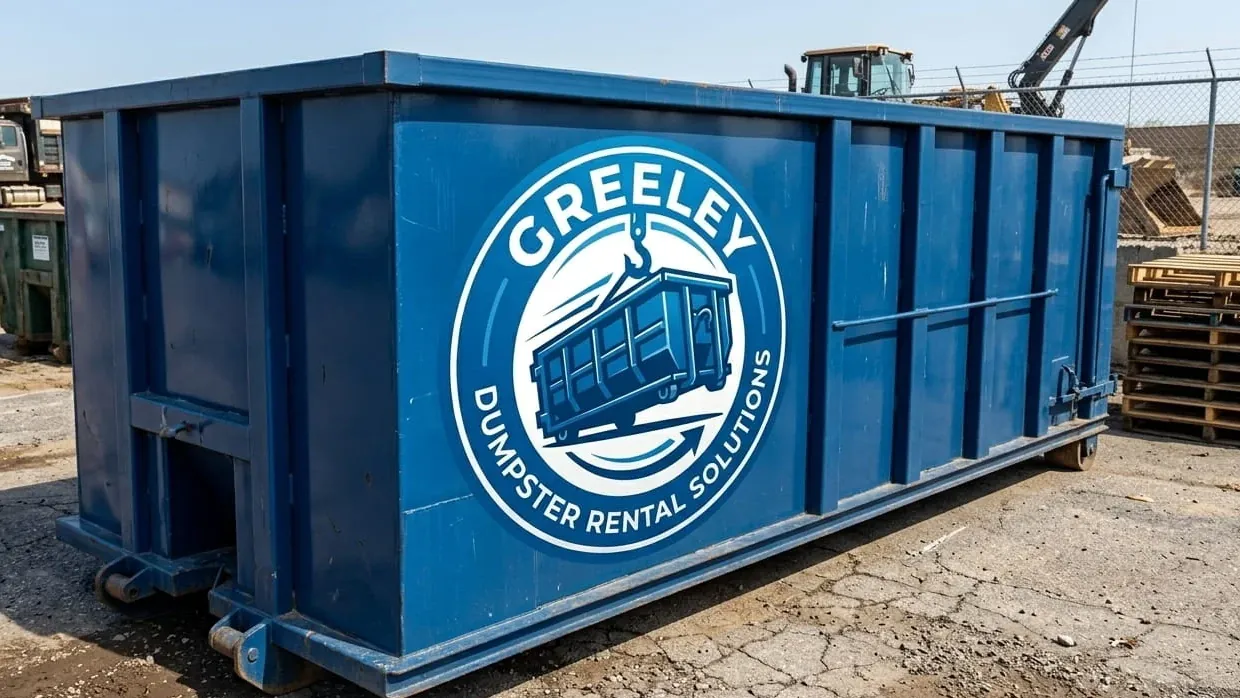
A 10 yard roll-off runs roughly twelve feet long, eight feet wide and about three and a half feet tall — call it three pickup loads, with sides low enough that most material goes in over the rim rather than being lifted. It is the container we send to the heavy jobs, and on a Greeley lot it fits about anywhere a car fits. Booked on the phone, quoted flat, and delivered with plywood under it as standard.
- Capacity10 cubic yards
- Box size12 x 8 x 3.5 feet
- Tonnage included2 to 3 tons
- Holdsaround 3 pickup loads
Why people choose the 10 yard
The 10 exists because weight and volume run out at different times, and on dense material weight runs out first by an enormous margin. Broken concrete, block, brick, stone, cured asphalt, tile set in a mortar bed, sod with soil attached, rock and trench spoil are all heavy enough that a container reaches a lawful road payload with a shallow, level layer of material on the floor. That is not a container being under-used; it is the container doing exactly what it is for. Put the same material into a 20 or a 30 and you get a box that physically cannot be hauled — which means unloading by hand, splitting into two pulls after the fact, or both. The small box is the arrangement that gets the driveway cleared in one visit.
Greeley produces more of this material than a milder market does, and the City’s own code says why. Greeley adopted the 2021 International Residential Code at § 22-76, effective 1 January 2023, and its adopted Table R301.2(1) specifies a frost line depth of 30 inches. Footings, water services and sewer laterals all go at least that deep, so every footing repair, service replacement and lateral dig here produces meaningfully more spoil than the same job somewhere warm. Add the age of the housing — a median year built of 1985, with roughly 46 percent of the stock predating 1980 — and old laterals, old water services and old foundations make deep digs ordinary recurring work in this city rather than rare events.
The second reason to take the 10 is that a clean load has routes a mixed one does not. Clean concrete, clean masonry and clean fill are their own accepted material streams at the facilities serving Weld County; concrete with framing, plastic sheeting and drywall through it is simply mixed construction debris. Keeping the streams apart at the point of demolition costs nothing, and separating them at the gate is not really possible. So on a job that produces both, the usual arrangement is a 10 for the heavy stream and a 20 or 30 for the rest. We will not publish gate rates for any facility — they are set by the operators and they change — but the difference in how a clean load is handled is real.
The last thing the 10 is good at is fitting. At about twelve feet it goes on a short Greeley driveway, down a side yard, into a tight alley approach on the older grid, or onto a small commercial pad without eating the whole lot. The low rail means a wheelbarrow can be run to it and tipped rather than lifted, which on masonry work is the difference between a morning and an afternoon. Load it as a single flat layer across the whole floor rather than heaping it in the middle: a heap concentrates weight over the rollers, makes the box harder to winch, and wastes the ends. Level with the top of the wheel wells is a good working guide on pure masonry or soil, and if you get there with material left over, stop and call — a second container is easy, an overloaded one is not.
Good fit for
- Broken concrete off a driveway, walk, patio or apron
- Block, brick, stone and chimney masonry
- Tile with a thick mortar bed behind it
- Trench, footing and sewer-dig spoil from a thirty-inch dig
- Sod, turf and root balls with soil attached
- Xeriscape rock, gravel and decorative stone
- Cured asphalt off a drive or parking area
- A small roof: a garage, a shed, a porch or a repair section
Not the right size for
- A whole-house clear-out, which wants a 20
- Bulky light material like furniture, packaging or brush
- A full house roof tear-off, which wants a 15 or a 20
- Framing, sheathing and decking off a demolition
- A commercial build-out full of ceiling grid and cardboard
- A yard full of storm debris after a wind event
Will it fit?
At about twelve feet long the 10 fits nearly anywhere a car fits, which makes it the container of choice on a short Greeley driveway, in a tight side yard, or on the alley approach that a lot of the older grid offers. The truck still wants roughly sixty feet of straight run, about eleven feet of working width and twenty feet of overhead clearance for the hoist — overhead is the usual obstacle here rather than the ground space, so service drops and mature limbs over the drop point get checked first. Because this box is nearly always loaded heavy, we plate it more carefully than the others: plywood under the wheels and rear rollers as standard, timber plating where the ground is disturbed, and a strong preference for concrete or compacted base over lawn or graded shoulder. The Colorado Geological Survey maps a potentially swelling-clay corridor with Greeley at its northern end, and clays that expand when wet are a real Front Range phenomenon — the Colorado Geological Survey maps the corridor, not your lot, so we will not tell you what is under your particular address, but a heavy box on soft ground after rain or a spring thaw is how driveways and lawns get damaged. And the container sits five feet clear of any combustible wall under Section 304.3 of the 2021 International Fire Code, which the City adopted at § 22-454 without amending Section 304. Two more things that apply once the box is on the ground. On the older Greeley grid an alley approach is frequently available and is often the better one for a heavy container, because it shortens the wheelbarrow run and keeps the truck off a narrow residential frontage — worth mentioning when you book. And § 12-272 of the municipal code makes it a violation for anyone other than the owner, occupant, lessee or tenant who placed a container to disturb it or its contents, which is the answer to the material that appears in a box overnight.
Ahead of the truck: shift the cars and the carts, and where the property runs on its own system, mark the septic lid, the drain field and the well head. Then tell us about anything the driver cannot see from the street — concrete poured recently, made or filled ground, an irrigation line run shallow beside the drive, a street still on base course waiting for its top lift, a low service drop or a shade tree standing over the only flat spot. A loaded box puts several tons onto four small pads. Dry, this ground carries that without complaint; ground that has just taken an irrigation set, a cloudburst or a thaw will press and hold the impression — which is why it is concrete rather than turf, with mats under every wheel and both rails as standard. And the box comes to rest five feet off any combustible wall, opening or combustible eave line. That is Section 304.3 of the 2021 International Fire Code, adopted by the City of Greeley at § 22-454 with effect from 1 January 2023 and left unamended at Section 304. The section carries a capacity threshold that has never once mattered to us, because every roll-off is many times over it — so the answer is five feet on all five boxes, measured off the nearest combustible surface rather than the plane of the wall. On private property — a driveway, a yard, a parking lot — no Public Space permit is engaged at all, which covers close to everything we set. Where any part of the box has to stand in a Greeley street, alley or sidewalk, the City names dumpsters directly in its own permitting guidance: “placement of dumpsters within the Public Space and roadways requires Public Space Traffic permits and proper signage.” That desk is Greeley Public Works Permits, 970-350-9881, at 2835 W. 10th Street. Do not lean on § 12-269(a), which lets a trash container sit on the right-of-way for one 24-hour period in seven — that is the weekly curbside rule for a household cart and not a pass for a roll-off. Fire clearance questions belong to Greeley Fire Prevention, (970) 350-9510, and everything else city-side to Greeley 311, (970) 351-5311. Past the city limits the answers change and we will not pretend they do not: in one of the separate Weld County municipalities, ask that town, because no town’s container or right-of-way rules were established by the research behind this site; on unincorporated ground it is Weld County, 1150 O Street in Greeley, (970) 400-4000, whose right-of-way language reaches the occupation of a county right-of-way without ever naming a dumpster, which warrants a call rather than an assumption. And where your own project involves digging — a footing, a stump, fence posts, a sewer lateral — Colorado 811 comes first on 811 or 800-922-1987: notice is two business days under C.R.S. § 9-1.5-103 excluding the day it is given, Colorado 811 itself asks for three, and the dig area gets marked in white beforehand. Our delivery and driveway protection guide and the Greeley placement and permit guide cover the rest.
Compare all five sizes
| Size | Box size | Tonnage included | Holds | Suits |
|---|---|---|---|---|
| 10 Yard Dumpster | 12 x 8 x 3.5 feet | 2 to 3 tons | around 3 pickup loads | Slab, block, brick and footing spoil — it reaches payload with the box still half empty. |
| 15 Yard Dumpster | 16 x 8 x 4 feet | 2 to 3 tons | around 4 to 5 pickup loads | One single-layer hail tear-off, or one room of an older house taken back to the studs. |
| 20 Yard Dumpster | 22 x 8 x 4.5 feet | 3 to 4 tons | around 6 to 8 pickup loads | The box that leaves our yard most: a basement and a garage cleared in one fortnight. |
| 30 Yard Dumpster | 22 x 8 x 6 feet | 4 to 5 tons | around 9 to 12 pickup loads | A whole-floor remodel, a lifetime of storage, or a May turnover. Shingle never rides in it. |
| 40 Yard Dumpster | 22 x 8 x 8 feet | 5 to 6 tons | around 12 to 16 pickup loads | Bulk with no weight in it — and it wants more room to land than anything else we run. |
Still weighing it up? Describe the pile and it gets sized on the phone inside two minutes. We have every incentive to get that right, because a wrong box costs this company more than it costs you. Ring (970) 888-6911.
Put a 10 yard on the board
One figure covering the drop, the pull, your days on site and the disposal. Same-day when the schedule allows.
(970) 888-6911The other four
Often booked with it
All sizes
The five boxes side by side
10 Yard Dumpster
Slab, block, brick and footing spoil — it reaches payload with the box still half empty.
View this size → 15yd³15 Yard Dumpster
One single-layer hail tear-off, or one room of an older house taken back to the studs.
View this size → 20yd³20 Yard Dumpster
The box that leaves our yard most: a basement and a garage cleared in one fortnight.
View this size → 30yd³30 Yard Dumpster
A whole-floor remodel, a lifetime of storage, or a May turnover. Shingle never rides in it.
View this size → 40yd³40 Yard Dumpster
Bulk with no weight in it — and it wants more room to land than anything else we run.
View this size →10 Yard Dumpster FAQs
Why is the small box the one for concrete?
Because the binding limit is lawful road weight, not room in the container. Concrete, block, brick, stone, cured asphalt, tile with a mortar bed, rock and soil are dense enough that a box reaches a legal payload with a shallow layer of material on the floor. A 10 loaded flat with broken driveway concrete is at weight while it still looks nearly empty from the street — that is normal and it is the correct result. Put the same material in a 30 and the container cannot lawfully be hauled, which means unloading it by hand or splitting it into two pulls after the fact. The small box is not a smaller job; it is the right tool for dense material, and it is the arrangement that clears the driveway in a single visit. Call (970) 888-6911 and tell us what the material is.
How full can I load it?
Level with the top of the wheel wells is a good working guide for pure masonry or soil, and material must always finish level with or below the rail — nothing proud of the top, because the load travels on a public road and has to be covered. Load it as a single flat layer across the whole floor rather than heaping it in the middle: a heap puts the weight over the rollers, makes the box harder to winch onto the truck, and wastes both ends. If you reach the guide line with material still to go, stop and call the yard rather than pressing on. A second container is straightforward to arrange; an overloaded one has to be dealt with by hand, and finding out at the gate is the expensive version of the same conversation.
Will a 10 take a roof?
A small one, yes — a detached garage, a shed, a porch roof or a repair section. It is not the box for a house. An ordinary single-layer asphalt tear-off on a Greeley house belongs in a 15, and a large roof, a two-layer tear-off or a job with the decking coming off belongs in a 20. The 10 does suit one specific roofing case well: gravel-surfaced built-up roofing, which is dense enough to behave like masonry. Roofing on a Greeley house is worth taking seriously in sizing terms, because roughly 46 percent of the city’s housing predates 1980 and second layers are common — every added layer roughly doubles the weight of the load. Count squares and layers, then call (970) 888-6911.
Can I mix concrete with the rest of the job?
You can, but on anything of size it costs more for two separate reasons. Weight first: a mixed container is limited by the densest thing in it, so a chimney’s worth of brick tipped into a box of framing takes the whole container to payload with the top half empty. Routing second: clean concrete, clean masonry and clean fill are their own accepted streams at the facilities serving Weld County, and a load with drywall, plastic and timber through it is simply mixed construction debris. Separating at the point of demolition is almost free; separating afterward is not. The usual arrangement on a Greeley site is a 10 for the heavy stream and a 20 or a 30 for everything else — see our heavy debris page.
Do I need a permit for one on my driveway?
No. On private property — a driveway, a yard, a parking lot — there is no Public Space permit in play at all, and that covers nearly every 10 we set. It changes only if part of the container has to stand in the street or on a sidewalk, and there Greeley names dumpsters directly: the City’s own permitting guidance states that “placement of dumpsters within the Public Space and roadways requires Public Space Traffic permits and proper signage.” The desk is Public Works Permits, 970-350-9881, at 2835 W. 10th Street, Monday to Friday 7 a.m. to 4 p.m. If the job involves a dig, call Colorado 811 as well — two business days by statute, three by their own advice, on 811 or 800-922-1987. Outside the city limits, Weld County, 1150 O Street, (970) 400-4000. See our permit guide.
Services
What goes into a 10 yard around here
Residential Dumpster Rental
Basements, garages and thirty years of storage out of a house that predates 1980.
Learn more →Commercial Dumpster Rental
Shops, restaurants and contractors inside the limits, where the City is the permit desk.
Learn more →Construction Dumpster Rental
Mixed C&D in one box, swapped next day anywhere the county seat reaches.
Learn more →Roofing Dumpster Rental
Counted in squares and layers, because hail is the job this county buys containers for.
Learn more →Roll-Off Dumpster Rental
Ten through forty yard boxes, out of the yard on 14th Avenue every working day.
Learn more →Same-Day Dumpster Rental
Ring before nine and there is usually an afternoon slot still on the board.
Learn more →Talk to a real person
Need a 10 yard in Greeley?
Describe the load — the room, the roof, the basement, the slab out the back — and you will get the size, the flat number and the day, on the phone, first time of asking. There is nothing on this site to fill in and nothing sitting in an inbox overnight.
Greeley and every one of the seventeen places we run to in Weld County · Mon–Fri 6:30am–5pm, Sat 7am–1pm