
Residential
Residential Dumpster Rental in Greeley, CO
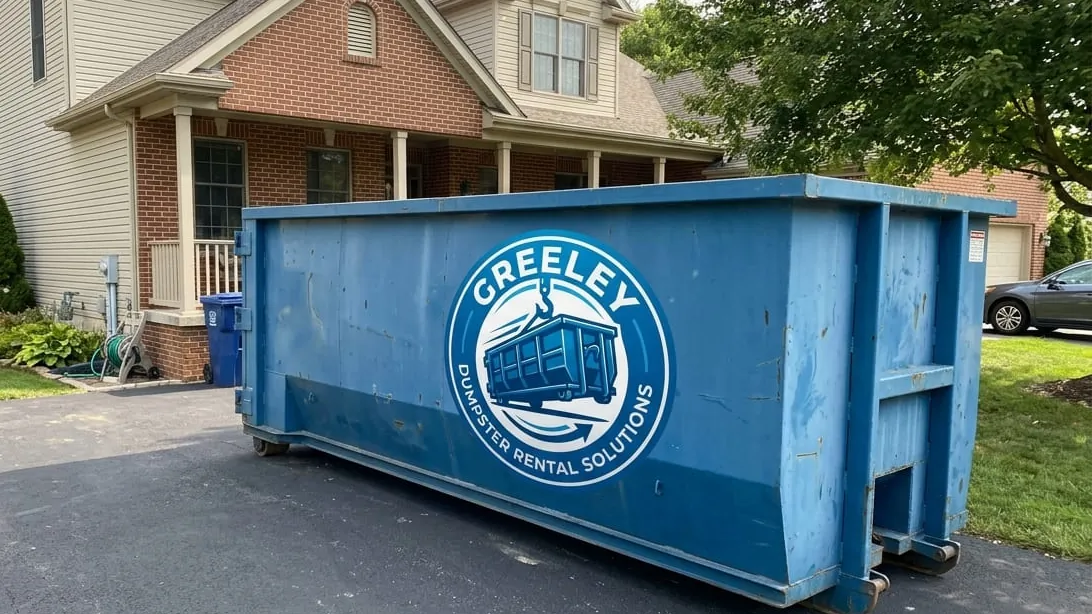
Driveway containers for Greeley houses — basements, garages, hail-damaged roofs and forty years of storage. On your own driveway no Public Space permit is in play at all, and every container sits five feet clear of a combustible wall.
Start with the thing that makes Greeley easier to work in than most of Colorado: somebody is in charge, and you can quote the section number. Greeley is a home rule city and the seat of Weld County, and it regulates refuse hauling as a licensed trade in its own code. Greeley Municipal Code § 8-368 provides that “all refuse haulers who collect, transport or remove refuse, garbage or ashes within the city shall be required to have a license,” § 8-369 sets vehicle standards, § 8-370 requires vehicle descriptions to be filed with the finance director, and § 8-371 declares the City “the sole agency for the collection and disposal of refuse” acting through “city-licensed operators.” Read together, those sections say something simple and useful: Greeley does not run the trucks. It licenses the people who do. There is no municipal truck coming for a basement’s worth of material, and there never was. Inside the Greeley city limits this is a City question — Greeley 311, (970) 351-5311.
The second fact is the age of the housing, and it is the one that shapes almost every residential job we set a container for. The median Greeley home was built in 1985. Roughly 46 percent of the city’s housing predates 1980, about 17 percent predates 1960, and 7.2 percent went up in 1939 or earlier. Nearly 29 percent of the entire stock was built between 1960 and 1979 — the ranch belt, houses now hitting sixty, on their second or third owner, ready for the kitchen, the bathrooms, the roof and the lower level all at once. Greeley is also 60.9 percent owner-occupied with a median household income of $69,881, — both figures readable from Census QuickFacts and the American Community Survey — which in practice means a great many of these jobs are done in stages by the people who live there rather than turned over to a general contractor. That changes the pace of a rental more than it changes the size.
Third: houses here have a downstairs. Greeley adopted the 2021 International Residential Code at § 22-76, effective 1 January 2023, and the City’s own adopted Table R301.2(1) specifies a frost line depth of 30 inches. Where footings, water services and sewer laterals have to go thirty inches down anyway, the marginal cost of a full basement is small, and basements are ordinary here as a result. So the standard Greeley clear-out is not a set of rooms, it is a vertical stack: a finished or half-finished lower level, a garage that has absorbed overflow since the Ford administration, and whatever went up into storage above. A sizing habit brought here from a warmer, flatter market comes up short every time. Our sizing guide works the arithmetic through in writing.
Fourth is the calendar, and in Greeley three of them land on top of each other. The average last spring frost is 12 May and the average first fall frost is 8 October, so outdoor demolition and landscaping really begin in May rather than March. The University of Northern Colorado’s academic year ends in early May — 8,807 students as of Fall 2025 in a city of about 115,073 that is 39.1 percent renter-occupied against 22.1 percent county-wide — so leases turn over in the same fortnight. And the City’s own Annual Spring Clean-Up runs two days in early May, residents only with photo ID. That event is the thing a Greeley homeowner reaches for first, and it is worth knowing before you plan around it: the City’s published exclusion list refuses “construction or demolition debris (including dirt, concrete, masonry, plywood, and similar materials),” and states that “vehicles with bagged loads will be turned away.” The Clean-Up line is 970-350-9336, and the City’s own site is greeleyco.gov; ask them for this year’s dates.
The practical end of it is short. On private property — a driveway, a yard, a parking lot — no Public Space permit is in play at all, and that covers the overwhelming majority of the houses we serve. If any part of the container has to sit in the street or on a sidewalk, Greeley is explicit about it: the City’s own permitting guidance states that “placement of dumpsters within the Public Space and roadways requires Public Space Traffic permits and proper signage,” and that desk is Public Works Permits, 970-350-9881, at 2835 W. 10th Street, Monday to Friday 7 a.m. to 4 p.m. Outside the city limits the question goes to Weld County at 1150 O Street, (970) 400-4000. Everything else is ordinary care: plywood under the wheels and the rear rollers, five feet of clearance from any combustible wall, and a tarp if wind is forecast. Call the yard on (970) 888-6911 and we will size it over the phone.
What Greeley Households Actually Clear Out
Basement And Lower-Level Clear-Out
The anchor job in this market. A thirty-inch frost line makes basements ordinary in Greeley, and a basement absorbs decades of boxes, shelving, a dead treadmill and the carpet that went down when the house was new. Set the box near the walkout or the garage door and the stair carry gets a lot shorter.
Garage And Shop Clean-Out
Detached garages and alley-loaded shops on the older grid fill with lawn equipment, lumber offcuts, bikes, paint and pallet racking. Drain the fuel and oil out of anything that has it, set the electronics aside, and route the paint and solvents to the county household hazardous waste facility rather than the container.
Hail-Damage Roof Replacement
Northeastern Colorado averages seven to nine hail days a year inside what NOAA calls the nation’s most hail-prone corridor, and roof tear-off is the single most common reason a Greeley driveway gets a container on it. It is a weight load rather than a volume load, so it goes in a smaller box loaded flat.
Whole-House Declutter Before A Sale
Furniture, closets, carpet, the garage and the storage level going out together in one push. This is the classic 20 yard job, and it is the one people most often under-size, because they estimate from the front door rather than from the basement stairs.
Kitchen And Bath Rip-Outs In An Older House
Cabinets, counters, tile, backer board, tub, vanity and flooring. In a Greeley house from the sixties or seventies the sequence matters as much as the size: identify the lead paint and the asbestos-containing material first, then plan the demolition around what that requires. Our lead and asbestos guide sets out the triggers.
Rental Turnover And Landlord Turns
With 39.1 percent of Greeley households renting, turns are a real and recurring job rather than an occasional one, and they cluster in May and again in August. A landlord clearing several units in a week cannot use the City clean-up, which is residents-only with photo ID and refuses bagged loads outright.
Fence, Deck And Shed Removal
Chinook downslope winds are a structural fact on this side of the range, and Weld County publishes a 115 mph basic residential design wind speed. Fence sections, deck boards, pergolas and sheds come down accordingly. Bulky rather than heavy, so the sizing logic inverts — take the bigger box.
Storm And Wind Debris Around The House
Siding, soffit, fascia, screens, downed limbs, roof litter and the neighbor’s trampoline. Mixed storm debris is light and awkward and it wants more volume than the weight of it suggests. Keep clean limbs and brush separate if you can — green waste has its own routes here.
Sizing A Container For A Greeley House
For a job with a clear edge on it — one bathroom, one kitchen, one bay of the basement, one ordinary roof — a 15 yard is usually right and it is cheaper. For the ordinary whole-house declutter the 20 yard is the Greeley default, and it is the default for a structural reason: with a thirty-inch frost line the job is a lower level plus a garage plus a storage level rather than a set of rooms, and that is more material than people estimate. The 10 yard is the weight box — broken concrete, tile set in mortar, sod, rock and the spoil off a thirty-inch trench all reach a lawful road payload long before they fill anything larger. Where the house is being emptied completely, step up to a 30. Roofing runs the other way and the ceiling is firm: an ordinary single-layer tear-off belongs in a 15, a large or two-layer roof in a 20, and roofing never goes in a 30 or a 40. Dimensions are on the container sizes page.
10 Yard Dumpster
Slab, block, brick and footing spoil — it reaches payload with the box still half empty.
View this size →15yd³15 Yard Dumpster
One single-layer hail tear-off, or one room of an older house taken back to the studs.
View this size →20yd³20 Yard Dumpster
The box that leaves our yard most: a basement and a garage cleared in one fortnight.
View this size →Driveways, Frost, Wind And Where The Box Goes
Placement on a Greeley lot comes down to four things. First, the surface. Plywood goes under the wheels and under the rear rollers on every delivery, because a loaded container puts its weight through two narrow contact patches and a driveway is usually the strongest flat thing on the lot. The Colorado Geological Survey maps a potentially swelling-clay corridor running from Fort Collins and Greeley in the north to Pueblo and Cañon City in the south, with clays that can expand up to twenty percent by volume when they get wet — we are not going to tell you what is under your particular address, but it is a good reason to keep a heavy box on concrete or compacted base rather than on soft ground after rain or a spring thaw. Second, the clearance. Greeley adopted the 2021 International Fire Code at § 22-454, effective 1 January 2023, and makes no amendment to Section 304, so the model rules apply as written. Under Section 304.3 a dumpster must not be stored inside a building or placed within five feet of a combustible wall. Every roll-off we place is far over the threshold, so the five-foot rule applies to all of them. Questions about a specific placement go to the Greeley Fire Prevention Bureau, (970) 350-9510. Third, the wind. An open container full of light material is a distribution system for a chinook, so tarp the load or put the heavy course on top. Fourth, the approach. We want roughly sixty feet of straight run for the truck, about eleven feet of working width and twenty feet of overhead clearance for the hoist, with an eye on service drops and mature limbs over the drop point. If the driveway will not take it, say so before delivery day and we will look at photographs first. Our driveway protection notes go through the rest. One more Greeley detail worth knowing: § 12-272 of the municipal code makes it a violation for anyone other than the owner, occupant, lessee or tenant who placed a container to disturb it or its contents. That is the polite legal backing for asking a neighbor not to top up your box overnight, and it is worth a sentence to the household before the container arrives rather than after somebody’s mattress appears in it.
Landed on the wrong page? Describe the job down the phone and you will be pointed at the right container, even where that means a different service entirely. Ring (970) 888-6911.
Get one flat number
Two minutes on the phone buys a size, a figure and a slot on the board. Nothing to fill in.
(970) 888-6911Sizes that suit it
How it works
Residential Dumpster Rental in four steps
- 1
Tell us the job
Two minutes, and a cross street and an avenue is enough to place you on this grid. You hang up with a flat number that has the disposal inside it.
- 2
We set it down
The driver walks the approach first, puts mats under both rails, and keeps the box the five feet clear of combustible wall that Section 304.3 asks for.
- 3
Fill it flat and low
Use the days in your window. Heavy on the bottom, nothing standing proud of the rail, and tarped — wind is the risk here, not rain.
- 4
Say the word
Ring or text and we pull it. Metal, cardboard and electronics come out on the way, and the rest goes to a gate permitted to take it.
Residential Dumpster Rental FAQs
Do I need a permit to put one on my driveway?
No. On private property — your driveway, your yard, your parking lot — there is no Public Space permit in play at all, and that covers almost every house we serve in Greeley. The permit question only arrives when part of the container has to stand on public ground. There the City is explicit: its own permitting guidance says “placement of dumpsters within the Public Space and roadways requires Public Space Traffic permits and proper signage.” That desk is Public Works Permits, 970-350-9881, 2835 W. 10th Street, Monday to Friday 7 a.m. to 4 p.m. One provision people find and misread: § 12-269(a) of the municipal code allows trash containers on the right-of-way “for one 24-hour period within a seven-day period” — that is the weekly curbside rule for a household cart, not a free pass for a roll-off. Outside the city limits, ask Weld County at 1150 O Street, (970) 400-4000. Our permit guide has the rest.
What size do most Greeley houses take?
A 20 yard, and the reason is the shape of the housing rather than the size of the family. Greeley’s own adopted residential code specifies a thirty-inch frost line, footings and services go that deep anyway, and full basements are ordinary as a result — so the standard clear-out is a lower level plus a garage plus a storage level going out together. That is more volume than most people estimate from the front door, and the commonest sizing mistake we hear on the phone is a 15 booked for a job that was always a 20. If the job genuinely has an edge on it — one bathroom, one kitchen, one bay of the basement — a 15 is right and it costs less. If the house is being emptied completely, take a 30. Describe it room by room on (970) 888-6911 and we will size it in a couple of minutes.
What can I not put in the container?
The hard bans first. Electronics have been banned from Colorado landfills since 1 July 2013 under C.R.S. § 25-17-303 — televisions, monitors, computers, printers and the rest. Tires are refused locally and routed to registered tire facilities under Colorado’s waste tire rules. Then the usual: liquids, paint, fuel, oil, solvents, pesticides, pool chemicals, pressurized tanks, batteries, hot ashes and anything containing asbestos. The good news in Weld County is that there is a free, local route for most of that. Weld County Household Hazardous Waste, 1311 North 17th Avenue in Greeley, (970) 400-2217, is open Tuesday, Thursday and Saturday 8 a.m. to 5 p.m. and is free to every Weld County resident — 200 pounds per household per visit, nothing over five gallons, no leaking containers and no plastic bags. It does not take electronics or appliances. Everything else — furniture, carpet, drywall, cabinetry, roofing, fencing, yard debris — is ordinary content. See our Colorado disposal guide.
My house is from the 1960s. Is there anything to sort out before demolition?
Yes, and in Greeley this is an ordinary question rather than an exotic one, because roughly 46 percent of the city’s housing predates 1980. Two separate rules with two separate dates. Lead paint is federal, keyed to housing built before 1978, and the certification belongs to the firm being paid to disturb the paint — note that Colorado is not an EPA-authorized state for that program, so firms certify with the EPA directly. Asbestos is a Colorado air quality matter under CDPHE Regulation 8, Part B: for a single-family home the trigger levels are 32 square feet, 50 linear feet, or the volume of a 55-gallon drum, a regulated project needs ten working days’ notice to the state, and that notice requirement also attaches to any demolition. Buildings built after 12 October 1988 are exempt. The CDPHE asbestos line is 720-507-5136. Both of those are obligations on the party doing the work, not on us — but they change the schedule, so tell us if they apply.
How long can I keep it?
On private ground, as long as the job needs. Call the yard on (970) 888-6911 when you want it collected and we will route it rather than hold you to a fixed day. The useful pattern on a bounded job is delivery the day before work starts and collection the day after it finishes. Two local notes on timing. The season starts later here than newcomers expect — the average last spring frost in Greeley is 12 May — and that same fortnight is when student leases turn over and the City runs its two-day Spring Clean-Up, which makes early May the busiest stretch of the Greeley year. And after a significant hail event, every roofer in town wants a container the same morning. If you can book ahead of either, do.
More services
Other things we haul
Commercial Dumpster Rental
Shops, restaurants and contractors inside the limits, where the City is the permit desk.
Learn more →Construction Dumpster Rental
Mixed C&D in one box, swapped next day anywhere the county seat reaches.
Learn more →Roofing Dumpster Rental
Counted in squares and layers, because hail is the job this county buys containers for.
Learn more →Roll-Off Dumpster Rental
Ten through forty yard boxes, out of the yard on 14th Avenue every working day.
Learn more →Same-Day Dumpster Rental
Ring before nine and there is usually an afternoon slot still on the board.
Learn more →Junk Removal Dumpsters
Empty a lower level, a garage or a rental unit at whatever pace suits you.
Learn more →Estate Cleanout Dumpsters
Unhurried container work for a family emptying a house somebody lived in for decades.
Learn more →Demolition Debris Removal
Porches, sheds, garages and interior strip-outs, with swaps that keep a crew moving.
Learn more →Concrete & Heavy Debris
Dedicated cans for slab, block, brick and footing spoil, loaded flat and low.
Learn more →Yard Waste & Brush Removal
Green material kept in its own load, because composting here is closer and cheaper.
Learn more →Where we deliver
Residential Dumpster Rental across Weld County and Northern Colorado
Same work, same flat rate, every district and town on this list. Open yours for the placement notes and the jurisdiction answer.
Talk to a real person
Need residential dumpster rental in Greeley?
Describe the load — the room, the roof, the basement, the slab out the back — and you will get the size, the flat number and the day, on the phone, first time of asking. There is nothing on this site to fill in and nothing sitting in an inbox overnight.
Greeley and every one of the seventeen places we run to in Weld County · Mon–Fri 6:30am–5pm, Sat 7am–1pm