
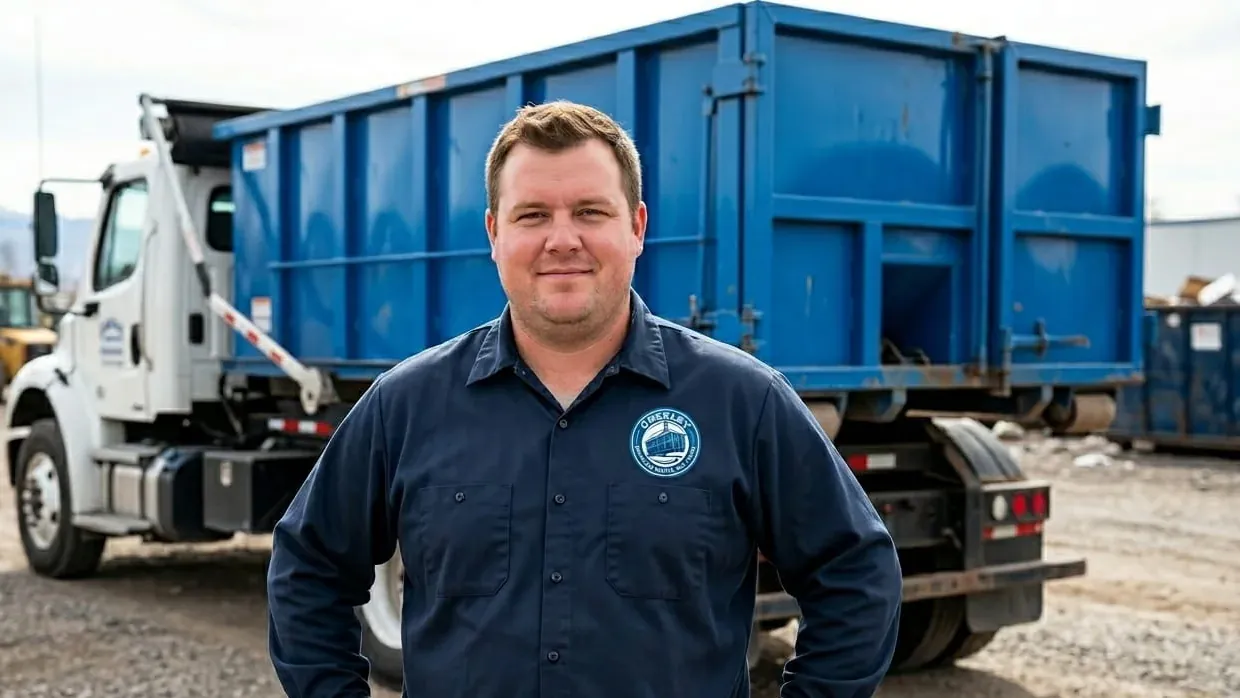
Evans, CO · Weld County
Dumpster Rental in Evans, CO
Roll-off containers run out to Evans from the yard on 14th Avenue here in Greeley — immediately south of Greeley, a short run down the highway from the yard. One flat number with the disposal already inside it, mats under the rails on every drop, and a same-day slot whenever the board still has one.
Roll-off containers for Evans homes and jobsites
First, the thing that has to be said before anything else: Evans is a home rule city in its own right. It is not a Greeley neighborhood. It has its own council, its own municipal code, its own permit counters and its own answers, and the fact that its northern boundary runs along the Greeley city limits does not change any of that. Anyone writing about this market who treats Evans as part of Greeley has told you, in one word, that they have never worked here.
Home rule matters, and it is worth understanding why. A Colorado home rule municipality draws its powers from its own charter under Article XX of the state constitution and can legislate on local matters beyond what state statute prescribes. That is exactly why the City of Greeley licenses refuse haulers, permits containers in its roadways, adopts its own building and fire codes and runs its own fire department. Evans has the same constitutional footing. What it has actually done with it, we did not establish — and that distinction is the whole point of this page.
So, plainly: we did not verify whether Evans licenses refuse haulers, whether it requires a permit for a container in its right-of-way, whether it has its own dumpster ordinance, which fire district serves it, or which editions of the building and fire codes it has adopted. Colorado has no statewide building code — adoption is entirely local and neighboring jurisdictions genuinely differ — so we cannot reason from Greeley’s 2021 editions to anybody else’s. Ask the City of Evans before you plan around a street placement. We are not going to publish a phone number we did not check.
What we can tell you about is the ground. Evans sits low, near the confluence country where the Cache la Poudre meets the South Platte, and it was hit hard in the September 2013 Colorado floods: homes damaged or destroyed, roads made impassable, the city’s main wastewater treatment plant heavily damaged, and two mobile home parks destroyed, one of them still being cleared nearly a year later. That is not ancient history in a town this size and it shapes the work — flood-related rebuilding, mobile home replacement, and the general reality that low ground near two rivers behaves differently in a wet spell.
The rest of the job mix is a normal Weld County city’s: house cleanouts, kitchen and bath remodels, roofs after hail, garage and yard clearances, mobile home park work, small commercial fit-outs, and the ordinary business of a place that grew alongside Greeley without becoming part of it.
What we know about working in Evans
Here is what we can state and what we cannot, kept strictly apart.
What we cannot state. Evans’ own rules. We did not establish whether the City of Evans requires a permit or written authorization to place a container in a city street, alley or right-of-way; whether it licenses or franchises refuse haulers; whether it has a dumpster provision in its code; which building and fire code editions it has adopted; or which fire protection agency covers which parts of the city. None of Greeley’s rules apply here — not the hauler license at § 8-368, not the Public Space traffic permit for a container in the roadway, not the 2021 IFC adoption at § 22-454, not the 2021 IBC at § 22-31 or the 2021 IRC at § 22-76. Those are the City of Greeley’s and they stop at the Greeley city limits. Ask Evans, get the answer from Evans, and tell us what you were told.
What we can state, because it does not depend on which city you are in. On private property — a driveway, a yard, a lot, a parking area — a right-of-way permit is not in play at all, because a right-of-way permit is about the public right-of-way. That is the great majority of what we set anywhere. And the container fire separation is five feet from a combustible wall in every International Fire Code edition in use in this region; every roll-off is far past the smallest capacity threshold involved, so five feet is the working number whichever edition Evans has adopted. That is not a guess about Evans’ code — it is the one thing that does not vary between the editions.
The county layer is the same for Evans as for Greeley, and it is genuinely useful. Weld County administration, the building department and the county right-of-way permit desk are all at 1150 O Street in Greeley, on (970) 400-4000, with Planning and Development Services on (970) 400-6100. And Weld County’s household hazardous waste facility at 1311 North 17th Avenue in Greeley is free to every Weld County resident, which an Evans household is: paint, solvent, thinner, pesticide, pool chemicals and automotive fluids, Tuesday, Thursday and Saturday 8 to 5, (970) 400-2217, capped at 200 pounds per household per visit, nothing over five gallons, nothing leaking, nothing in plastic bags. Electronics and appliances are not accepted there, and electronics have been banned from Colorado landfills since 2013 under C.R.S. § 25-17-303. One thing that is not available to you: the Greeley Annual Spring Clean-Up is City of Greeley residents only, with photo ID. Living next door does not qualify.
The state and federal layers apply identically everywhere. Lead: compensated renovation disturbing paint in pre-1978 housing triggers the federal rule, and firms certify with the EPA directly because Colorado is not EPA-authorized for that program. Asbestos: CDPHE Regulation 8, Part B, single-family triggers of 32 square feet, 50 linear feet or a 55-gallon drum, 10 working days’ notification for removal above trigger and for any demolition, $60 notice, $180 single-family permit, exemption only after 12 October 1988 — 720-507-5136, CDPHE. Colorado 811: two business days by statute under C.R.S. § 9-1.5-103, three on the association’s own advice, white-line the area first — 811 or 800-922-1987. That one deserves emphasis here, because Weld County produces more than 80 percent of Colorado’s oil and gas and gathering and flow lines cross ground that owners frequently do not know about.
One local note on ground conditions rather than rules. Low ground near the rivers stays soft longer after rain, and a loaded container concentrates its weight under the rails rather than spreading it. We carry plywood and we would rather set on a hard surface. If your only spot is turf or gravel over river bottom, say so when you book.
And one discipline about flood ground, since Evans has real flood history. We will talk about surfaces, drainage and what a wet week does to a lane, because those are things a driver can see. We will not make a flood-zone claim about your address. Flood mapping is a federal and municipal matter, it changes, and no dumpster company should be telling you what zone your lot is in from a web page. What is verifiable is what happened: the September 2013 Colorado floods damaged and destroyed homes here, made roads impassable, heavily damaged the city’s main wastewater treatment plant and destroyed two mobile home parks, one of which was still being cleared nearly a year later. That is why flood-related rebuilding, mobile home replacement and long-deferred cleanups are still ordinary work in this city.
- RegionWeld County
- Distance from our yardImmediately south of Greeley, a short run down the highway from the yard
- Main routesUS 85 south out of Greeley
- Typical deliverySame or next day
Getting a truck to you
Evans is a short run for us — south down the highway from the yard, or in off the numbered avenues where the Greeley grid runs to the boundary. The town is easy to move around, so the questions are all about the last hundred feet. In the older central grid the drives are narrow, the aprons are old and the overhead has been there longer than the trucks, so a 15 is often the sensible box even when the volume argues for a 20. In the newer subdivisions on the western side the drives are wide and square and a 20 or a 30 goes in without difficulty. In the mobile home parks and on the river-bottom ground the constraint is nearly always the surface: gravel and packed dirt that carry a pickup all year do not necessarily carry a loaded roll-off truck back out after a wet week, and low ground here stays soft longer than people expect. We carry plywood and lay it under the wheels as a matter of course. A 20-yard container wants roughly sixty feet of straight approach, about eleven feet of working width and better than twenty feet of clear overhead. Two other local habits: we keep loads level with the rails and covered, because this is chinook country and Weld County publishes a 115 mph basic residential design wind speed; and in winter we look at the grade before we plan a pickup, because an iced slope changes what can safely be lifted. (970) 888-6911.
Routes we run: US 85 south out of Greeley, US 34 Business through the north side of the city, 37th Street and the east–west routes across town, 11th Avenue and 35th Avenue south from the Greeley grid, the county roads east toward the South Platte.
Landmarks and neighborhoods we work around
Local landmarks
- a home rule city with its own government and its own municipal code
- the South Platte and Cache la Poudre bottoms east and north of town
- the US 85 corridor running south from Greeley
- the Greeley city limits along the northern edge
- Garden City, the 72-acre town Evans shares a boundary with
- Weld County administration on O Street in Greeley
Neighborhoods & communities
- the older grid in the center of the city
- the newer subdivisions on the western side
- the ground along the US 85 corridor
- the low-lying areas near the river bottoms
- the commercial frontage along the highways
- the northern edge where Evans meets the Greeley city limits
Permits, streets and placement in Evans
Start with the question that decides everything else: which government are you standing in. In Evans the answer is short and it is not Greeley. Evans is a home rule city lying wholly inside Weld County, with its own government, and that government is not the City of Greeley’s. It sits immediately south of Greeley with its own charter, its own council and its own code, and it is not a Greeley neighborhood — treating it as one is the fastest way to get a permit question wrong. Being home rule, Evans is among the places most likely to have written machinery of its own; what it has actually written, we did not establish. One town, one county, one county seat — the county part of the answer is the same as it is everywhere else on this site, because all seventeen places we serve are in Weld. It is the municipal part that changes at the town line, and it changes completely.
Here is why that is worth a paragraph rather than a footnote. A home rule municipality takes its powers from a charter of its own under Article XX of the Colorado Constitution, and on local matters may legislate past what state statute lays down. A statutory town works from the statute alone. Greeley is home rule and is the fullest expression of what that permits: it licenses refuse haulers at § 8-368, declares itself the sole agency for refuse collection through city-licensed operators at § 8-371, names dumpsters directly in its own Public Space permitting rules, regulates containers on the right-of-way at § 12-269, and adopts the 2021 fire, building and residential codes at §§ 22-454, 22-31 and 22-76. Every one of those is City of Greeley machinery and every one of them stops at the City of Greeley’s boundary. We list them here precisely so you can see what does not apply to an Evans address. Read them in the Greeley municipal code if you want to see what a fully built-out municipal regime looks like — then remember it is not yours.
And now the honest part. We did not establish whether Evans licenses or franchises refuse haulers, whether it requires a permit or written permission for a container in its street, alley or right-of-way, whether it has a dumpster ordinance of its own, which fire protection district responds there, or which editions of the building and fire codes it has adopted. Not one of those. That is five open questions and we would rather hand you five than answer them from memory, because a confident wrong answer about another government’s rules is the worst thing a page like this can do. “We could not find one” is not the same sentence as “there is none.” The research behind this page did not establish a phone number for Evans that we are willing to reprint — what a search returns is aggregator listings rather than the town’s own page, and a wrong number printed confidently is worse than no number at all — so take these questions to the town clerk directly. Outside the town limits the county takes over, and there the answer is the same for everyone on this site. Greeley is the county seat, and that is not a ceremonial fact. Weld County administration, the county building department and the county right-of-way permit desk are all at 1150 O Street in Greeley on (970) 400-4000, with Planning and Development Services on (970) 400-6100. Weld County is 3,984.94 square miles and 378,426 people, and every county permit counter that touches a construction job anywhere in it is here. A contractor working out at Briggsdale or Keenesburg sorts the paperwork in Greeley.
Now the part most of our competitors skip. Start with the line that is safe everywhere, because it is the one that covers nearly every job: private property — a driveway, a yard, a parking lot — engages no right-of-way permit at all. Neither the town’s nor the county’s, anywhere in this service area. On your own driveway in Evans the constraints we know of are the fire clearance, your covenants, a landlord’s consent and whether the approach will carry a loaded truck — and the driveway is where we would rather set the box in any case.
If any part of the container will stand in the street, the alley, the sidewalk or the verge, that is right-of-way, and inside an incorporated place the right-of-way belongs to the municipality rather than to the county. Evans is that municipality, and we did not read Evans’s code. We will not print an Evans fee, tier, form or turnaround that we have not read. What we can show you is what the sequence looks like where it is written down, so you know what you are asking for. In Greeley the City’s own permitting guidance says “placement of dumpsters within the Public Space and roadways requires Public Space Traffic permits and proper signage,” issued by Public Works Permits at 2835 W. 10th Street; and § 12-269(a) separately allows a household trash container on the right-of-way for one 24-hour period in seven days, which is a curbside rule and not a roll-off pass. That is the City of Greeley’s paperwork and it stops at the City of Greeley’s boundary. Different government, different paperwork, same truck. Ask the Evans town clerk before you plan around a street placement rather than after — and ask them, not us, because it is their street. Outside the town limits the desk is Weld County Public Works, at 1150 O Street in Greeley, on (970) 400-4000. And permission or no permission, ring Colorado 811 before anything at all is dug, trenched, driven or pulled out of the ground.
One rule belongs to the driveway itself, and it is a fire rule. Section 304.3 of the International Fire Code provides that a dumpster must not be stored inside a building and must not be placed within five feet of a combustible wall. There is a threshold in that section expressed in cubic yards, and it does not matter here: every roll-off we run is far over it — even a 10 yard is ten cubic yards — so the five-foot rule applies to all of them, always. The debate you will find on the internet about which subsection and which capacity is academic; say five feet and stop. Measure it from the nearest combustible surface rather than from the wall plane, because on an Evans lot with a deep eave and a narrow side yard the eave line is what actually decides where the box can sit, and we take that measurement before the rails come off the truck. Two more rules from the same section are worth having on a working site: containers over forty gallons need lids, and materials liable to spontaneous ignition — oily rags, stain and sealant-soaked cloths — belong in a listed disposal container rather than loose in a roll-off. That is a real jobsite fire cause, not a paper rule. Which fire authority covers an Evans address, and which edition it enforces, we did not establish and we will not characterize it. That authority — not the county switchboard and certainly not Greeley’s fire department — is the desk to ask, and fire district boundaries do not follow municipal boundaries. The five feet is the part that does not vary, so work to it while you find out the rest.
Last, the run in. Getting a box off the rails cleanly wants roughly 60 feet of straight, about 11 feet of width and 20-plus feet of nothing overhead. In Evans what fails that test is hardly ever the road. It is the final hundred feet of it. Nothing in this county is mountain driving — Greeley stands at 4,676 feet where the Cache la Poudre joins the South Platte, and a truck works a numbered grid in town and a section-line grid outside it — so the obstacles are small, local and entirely predictable once somebody has looked. On the old platted blocks: a service drop slung low over the only way in, a shade tree that has had sixty years to spread, a lot too narrow to swing on, an alley wanting the carts moved and the gate unlocked before we arrive. On the newer western ground: turf laid last month, an irrigation line run shallow alongside the drive, a street sitting on base course and waiting for its top lift. Out on acreage: a quarter mile of lane that has carried a pickup all winter and will cut up under nine tons in April. Walk it, look up, and tell us what you found.
Two questions follow the load rather than the address, and neither is settled at a town hall. The first is what the box is allowed to carry. CDPHE writes the solid waste rules at 6 CCR 1007-2, but the instrument that lets a disposal site exist at all is a county one: a certificate of designation under C.R.S. § 30-20-102, issued by the governing body with jurisdiction and reviewed by the state. Here that governing body is Weld, and the building it works out of is 1150 O Street in Greeley. Past a short list of statutory bans there is no master schedule of refused materials in this state — every facility writes its own into an approved operating plan. Which is why we ask what is going in the box while we are quoting it, rather than finding out when the ticket comes back.
The bans are brief and two of them trip people up. Electronics have been shut out of every Colorado landfill since 1 July 2013 under C.R.S. § 25-17-303, so a television, a monitor or a tower needs a recycler — and the county hazardous waste counter will not take them either, which is the surprise we field most often. Waste tires are refused at the gate, and moving ten or more of them takes a state registration, so they never travel with us. Green material runs the opposite way: Colorado has never put a statewide landfill ban on yard waste, and the gates serving this county list branches and vegetation among what they accept. We still keep it in its own load, for money rather than law. The City’s GROW Center on 970-673-3718 takes grass, leaves, plants, limbs, branches and untreated lumber, though anything painted, stained or nailed together stopped being clean wood the day it went up, and A-1 Organics composts at Eaton on 970-454-3492. Everything wet or reactive — paint, solvent, fuel, automotive fluid, a battery, a propane cylinder, pool chemicals — has somewhere free to go three days a week at 1311 North 17th Avenue here in Greeley, on (970) 400-2217.
Asbestos is where we stop, and there is no version of the job where we do not. Nothing containing it rides in one of our containers. Colorado files it under air quality rather than waste, which catches out anyone who has worked in another state: the CDPHE Air Pollution Control Division administers it under Regulation 8, Part B. On a single-family house the thresholds are 50 linear feet of pipe covering, 32 square feet of anything else, or a 55-gallon drum by volume; a certified inspector goes in first; the notice period is ten working days; the published fees are $60 for a notice and $180 for a thirty-day permit; and a demolition has to be notified whatever the quantity turns out to be. Anything built after 12 October 1988 is exempt where the documentation shows no asbestos-containing material was used. The line is 720-507-5136. None of that is ours to file — but every bit of it sits in front of the container, and a job halted by an inspector costs a great deal more than a week of waiting for one.
The other year to know is 1978, the cut-off for the federal Renovation, Repair and Painting rule, and Colorado handles it backwards compared with most of the country: the state never took the program over, so a firm working on pre-1978 housing certifies with EPA itself. Whether that matters at all depends on where you are standing, and standing here it matters constantly, because close to half of Greeley predates the rule. The median house went up in 1985, roughly 46 percent of the stock is older than 1980, and 7.2 percent of it was already standing in 1939. That is the reason our guide to lead and asbestos in older Greeley homes sits on the front page of this site instead of at the bottom of it. One last item, and it is the one people skip. Ring Colorado 811 on 811 or 800-922-1987 before a shovel goes anywhere. C.R.S. § 9-1.5-103 puts the notice at two business days, not counting the day you give it; Colorado 811 asks for three; take the three and you cannot be caught short. Mark the dig in white before you call. Setting a box on a driveway triggers none of this. A footing, a fence line, a stump or a sewer lateral triggers all of it.
What the box stands on settles more arguments in Evans than what size it is, and nearly every habit carried in from a rainier part of the country is the wrong habit here. Greeley sits at 4,676 feet on flat irrigated plain, and the 1991–2020 normal at Greeley–Weld County Airport — our own station, not a borrowed one from down the range — is 15.34 inches of precipitation in a year. What happens below the surface at your particular address is not something we will publish. That takes a geotechnical investigation, and guessing at it in print helps nobody. What is public, regional and genuinely useful is that the Colorado Geological Survey maps a potentially swelling-clay corridor running from Fort Collins and Greeley in the north to Pueblo and Cañon City in the south, with this city at the northern end of it, and clays of that sort can take up a great deal of water. The part we actually work with is the top few inches. Several tons ride on four small pads under a loaded container. Dry, this ground carries them without complaint. Come back after an irrigation set, a cloudburst or a thaw and it will take an impression and keep it. Hence the one rule we never bend: concrete rather than turf, mats under every wheel and both rails, on every drop, in every month of the year — and after a wet week we would sooner move a date than cut up two hundred feet of somebody’s drive.
The houses were built for that climate, and they have a floor below grade. Table R301.2(1) of the residential code Greeley adopted publishes a 30-inch frost line, and the county publishes the same number, so footings, water services and sewer laterals all begin below it. A trench that would be trivial in a warm state is a real excavation here, and trench spoil is the heaviest material that comes off a house. That makes a footing repair or a lateral replacement a 10 yard loaded low conversation and never a 20 yard one. Where it changes a cleanout is the stairs, because hand-carrying is the job: a smaller box set close to the walkout beats a bigger one parked wherever suited the truck. Two dates belong in the same breath, since they decide when outdoor work can start at all — the average last spring frost is 12 May and the first fall frost is 8 October. And because it comes up whenever a lower level is opened up: on radon we quote EPA rather than a map, and EPA’s position is that elevated readings have turned up in every zone it draws, so “all homes should be tested, regardless of zone designation.”
The age of the housing splits this market in half, and it is the half nobody expects who knows northern Colorado only from the newer corridor towns. The median Greeley home dates from 1985. Roughly 46 percent of the stock is older than 1980 and 7.2 percent of it was standing before 1940, while 39.1 percent of households here rent, against 22.1 percent across the county. So: an old city sitting inside the fastest-growing county in the state. 115,073 people on 49.09 square miles, incorporated 15 November 1885 out of the 1870 Union Colony, at the middle of a Weld County of 378,426 that turns out over 80 percent of Colorado’s oil and gas and $2.38 billion of agricultural product a year. Those figures are Census. Translated into containers it means two different loads on the same street: one is plaster, cast iron, pre-1978 paint and a third covering of shingle, the other is new-build tidy-up and a first remodel. The older one weighs considerably more, and it is the one we get called for.
Then the weather, where one hazard outranks the rest of the list put together. Hail is what pays for containers in this county. Northeastern Colorado runs seven to nine hail days a year inside the most hail-prone corridor in the United States, and the work never spreads itself out. It lands in one week, after one storm, with every roofer in Weld dialing the same numbers before eight in the morning. If your roof has just been hit, book it that day — and know that on a Greeley roof there is a sizing consequence attached, because a second course of asphalt still on the deck reaches lawful payload while the box still looks part used. Wind is second, and it is the one that damages property. Chinook downslope events come off the range hard enough to have produced recorded Front Range gusts of 137 mph, and the county publishes a residential design wind of 115 mph. A county does not write a figure like that down for decoration. An empty box walks, a heaped one redistributes itself along the street, and a loose tarp is a kite — so we weight whatever we cover, and we would rather tuck a container behind a windbreak than leave it standing in the open. Third, tornadoes: Weld has recorded more of them than any county in the United States, most of them short-lived landspouts on the Denver convergence zone, most of them on afternoons that looked unremarkable from the ground. Evans has its own reference point for that. In September 2013 the South Platte and the Cache la Poudre flooded low-lying neighborhoods in Evans and Greeley; the city’s main wastewater treatment plant was heavily damaged and two mobile home parks were destroyed, one of them still being cleared nearly a year later. We call it the September 2013 Colorado floods, because that is what it was. Warnings come out of NWS Denver/Boulder on 303-494-3210. A container left open through a real storm fills with water and grit, and you then pay us by the ton to carry it away. Cover it, or ask us for a tarp.
And there is one more calendar worth planning around here that no other market in this county has. Every May, three things land in the same fortnight. The last frost lifts around 12 May, so outdoor demolition and landscaping start. The university’s academic year ends in early May and leases turn over in a city that is 39.1 percent renter-occupied. And the City runs its two-day Spring Clean-Up, the one that refuses construction and demolition debris and turns away bagged loads. We do not publish a statistic about it, because there is not an honest one to publish — but that is the shape of the Greeley year, it is the busiest fortnight we have, and the practical advice is simply to book earlier in the first half of May than you think you need to. The other end of that cycle is mid-August. Our guide to move-out and rental turnover is written for landlords and property managers who live with both ends of it.
Collection in Evans is the city’s own business on its own limits. It is not Weld County’s and it is emphatically not Greeley’s, and we are not going to publish Evans’s cart rules, bulky-item rules or collection day from memory. That one is for the Evans town clerk as well. One thing we can tell you with confidence: the City of Greeley’s Annual Spring Clean-Up is for Greeley residents with photo ID, so it is not a route for an Evans address — and in any case its own published list refuses “construction or demolition debris,” which is what most of our customers actually have. One thing holds true across the whole of this market, and it is the part that concerns us: no cart program anywhere in it was ever designed for construction and demolition debris. Shingle, drywall, cabinets, tile, concrete and framing lumber are ours to deal with, whichever side of a municipal line the house happens to stand on.
Beneath the town sits the county, and that layer catches out anybody who arrived from a place with a weekly truck. Weld County collects no residential waste anywhere in the county. Whatever Evans does or does not provide inside its own limits is the Evans government’s business, and the county layer underneath it does not collect from anybody. What the county runs instead is drop-off. Weld County runs a household hazardous waste facility at 1311 North 17th Avenue in Greeley — free to every Weld County resident, open Tuesday, Thursday and Saturday, 8 to 5, on (970) 400-2217, capped at 200 pounds per household per visit, nothing in a container over five gallons, nothing leaking and nothing in a plastic bag. Electronics and appliances are not accepted there, so those need a route of their own. Paint, solvents, pesticides, pool chemicals and automotive fluids cannot go in a roll-off, and this is where they go instead. The county also publishes a seasonal landfill voucher, one per Weld County address, for a single load. Every one of the seventeen places on this site is in Weld County, so both of those are open to every customer we have — which is a genuinely useful thing about working in one county instead of two. None of it is a curbside service and none of it takes job debris. From there, two things travel with the load rather than with the address. Where it ends up is the first — a facility permitted to receive that class of waste, and a concrete tear-out does not go to the same gate as a roof. What it weighs is the second, since disposal is billed by weight, which is precisely why the question about contents comes before the quote and not after it. Your half of that is being straight with us about whether the load is light and bulky or heavy and dense, because that is the difference between one haul and two. The rest is in construction debris disposal in Weld County.
Sizes we deliver to Evans
10 Yard Dumpster
Slab, block, brick and footing spoil — it reaches payload with the box still half empty.
View this size → 15yd³15 Yard Dumpster
One single-layer hail tear-off, or one room of an older house taken back to the studs.
View this size → 20yd³20 Yard Dumpster
The box that leaves our yard most: a basement and a garage cleared in one fortnight.
View this size → 30yd³30 Yard Dumpster
A whole-floor remodel, a lifetime of storage, or a May turnover. Shingle never rides in it.
View this size → 40yd³40 Yard Dumpster
Bulk with no weight in it — and it wants more room to land than anything else we run.
View this size →Delivering to Evans today
Ring before nine and Evans is usually an afternoon drop. Out at the far edge of the county we will say plainly when tomorrow morning is the better booking.
(970) 888-6911Nearby places
Popular in Evans
Services in Evans
What we haul in and out of Evans
Residential Dumpster Rental
Basements, garages and thirty years of storage out of a house that predates 1980.
Learn more →Junk Removal Dumpsters
Empty a lower level, a garage or a rental unit at whatever pace suits you.
Learn more →Roofing Dumpster Rental
Counted in squares and layers, because hail is the job this county buys containers for.
Learn more →Construction Dumpster Rental
Mixed C&D in one box, swapped next day anywhere the county seat reaches.
Learn more →Yard Waste & Brush Removal
Green material kept in its own load, because composting here is closer and cheaper.
Learn more →Estate Cleanout Dumpsters
Unhurried container work for a family emptying a house somebody lived in for decades.
Learn more →How it works
Delivering to Evans in four steps
- 1
Tell us the job
Two minutes, and a cross street and an avenue is enough to place you on this grid. You hang up with a flat number that has the disposal inside it.
- 2
We set it down
The driver walks the approach first, puts mats under both rails, and keeps the box the five feet clear of combustible wall that Section 304.3 asks for.
- 3
Fill it flat and low
Use the days in your window. Heavy on the bottom, nothing standing proud of the rail, and tarped — wind is the risk here, not rain.
- 4
Say the word
Ring or text and we pull it. Metal, cardboard and electronics come out on the way, and the rest goes to a gate permitted to take it.
Dumpster Rental in Evans — FAQs
Is Evans part of Greeley?
No, and this is worth being firm about. Evans is a home rule city in its own right, with its own council, its own municipal code and its own permit counters. It shares a boundary with Greeley and it shares a boundary with Garden City, and it is part of neither. None of the City of Greeley’s rules — the hauler license at § 8-368, the Public Space permit for a container in the roadway, the adopted 2021 fire code, the Greeley Fire Department — apply on an Evans address. Give us the street address and the city and we will work from there.
So do I need a permit for a container in an Evans street?
We do not know, and we are not going to pretend otherwise. We did not establish Evans’ own rules on container placement, right-of-way permits or hauler licensing, and we will not publish a phone number we did not verify. Ask the City of Evans directly before you plan a street placement. What we can tell you is that on your own driveway, yard or parking area, a right-of-way permit is not in play at all — and that is where we would rather put the box anyway.
Which fire code applies in Evans?
We did not establish it, and Colorado gives us no shortcut: there is no statewide building or fire code, so every jurisdiction adopts its own edition on its own date and neighboring towns genuinely differ. Greeley’s 2021 editions tell you nothing about Evans’. What does not vary is the container rule itself: five feet from a combustible wall, in every edition in use around here, and every roll-off is far over the smallest capacity threshold involved. So five feet is what we set to.
Is the county household hazardous waste site free to us?
Yes. It is free to every Weld County resident and an Evans household is one. 1311 North 17th Avenue in Greeley, Tuesday, Thursday and Saturday 8 to 5, (970) 400-2217: paint, solvents, thinners, pesticides, pool chemicals and automotive fluids, capped at 200 pounds per household per visit, nothing over five gallons, nothing leaking, nothing in plastic bags. Electronics and appliances are not accepted and need a separate route. The Greeley Spring Clean-Up, by contrast, is Greeley residents only with photo ID — that one is not open to you.
The ground behind the house is soft. Can you still set there?
Usually, with plywood and an honest conversation first. A loaded container puts its weight through the rails rather than spreading it, so soft ground marks under the rails long before the box feels heavy. Low ground near the river bottoms here holds water and stays soft longer than people expect, and a lane that carries a pickup all winter will not necessarily carry a loaded roll-off truck back out after a wet week. Tell us what the surface is, whether it slopes, and how long the box needs to stand there. Driveway and ground protection.
Do Greeley’s dumpster rules apply in Evans?
No, and that is the single most important thing on this page. Evans is a home rule city with its own government. Greeley’s hauler license at § 8-368, its Public Space traffic permit for a container in the roadway, its § 12-269 right-of-way provisions and its 2021 fire, building and residential code adoptions are all City of Greeley machinery, and they stop at the City of Greeley’s boundary. We did not establish Evans’s own rules on hauler licensing, container or right-of-way permits, a dumpster ordinance, its fire district or its code editions, and we are not going to guess them for you. Ask the town before you plan around a street placement. For county-level questions, Weld County is at 1150 O Street in Greeley on (970) 400-4000. On private property — your own driveway or yard — no right-of-way permit is in play anywhere, which covers nearly every job we set.
How quickly can you deliver a dumpster to Evans?
Evans is immediately south of Greeley, a short run down the highway from the yard, which puts it on a route we run without having to think about it. Call before nine and same day is usually live; otherwise it is the next morning. It gets softer at the outer edge of the county — Platteville, Galeton and the far section roads are scheduled in blocks, so out there a same-day set is a maybe and we will say so. Three things reliably take a day off the board. Snow deep enough to change where a box can safely be set and pulled. The week after a hailstorm, when every roofer in Weld rings before eight. And the first half of May, when the frost date, the university move-out and the City clean-up all land inside the same fortnight. Ask for the honest day rather than the hopeful one and the honest day is what you get.
Do you charge extra to deliver to Evans?
No. Evans is inside the standard area, and the number is the one we would quote for the same job in Greeley. The pull, the days you keep it and the disposal up to the agreed tonnage all sit inside that single figure — no fuel line, no environmental line, no administration line underneath it.
What size dumpster do most Evans customers take?
The 20 yard, and it is not close. That is what a whole-house declutter takes, and in a city whose adopted residential code publishes a 30-inch frost line — so basements are ordinary — it is also what a lower level and a garage cleared together take. Roofing runs the opposite direction. A tear-off never goes in a 30 or a 40, because shingle hits lawful payload while there is still room in the box, so a single-layer hail job wants a 15 yard and a big roof, a second course or decking coming off wants a 20 with a second pull behind it if it needs one. The same downward logic covers broken concrete, a front walk, footing spoil and anything soaked after high water: take the smaller box twice. Green material earns a load of its own as well — not because of a ban, since Colorado has none, but because a clean separated load has a cheaper gate waiting for it.
Nearby
Places we serve around Evans
Talk to a real person
Need a dumpster in Evans?
Give us the job and the address. It gets sized, priced flat, and put on the board. Evans is on the run most days, so a same-day slot is often still open.
Evans, CO · Weld County · delivered from 514 14th Ave, Greeley, CO 80631