Sizes
What Size Dumpster Do I Need in Greeley, Colorado?
National size charts assume a house built in the last twenty years. Greeley's median home was built in 1985, and old houses give up heavy debris. Here is how we size containers here.
Most size charts are written for a house that does not exist in Greeley. They assume a light, bulky, recent load — packaging, drywall offcuts, a bit of framing scrap — because that is what a subdivision built in the last twenty years produces. Greeley is not that city. The median Greeley home was built in 1985, roughly 46 percent of the housing stock predates 1980, and about 17 percent of it was built before 1960, according to the Census Bureau’s American Community Survey five-year estimates. Those houses give up plaster, lath, cast iron, layered roofing and deep excavation spoil, and all of that is heavy.
So the honest sizing answer here starts with a warning: in an older city, the container you can fill and the container you can lawfully haul are often two different containers. Below is how we size for Greeley jobs, what each of the five boxes is genuinely for, and the two rules that override every chart on the internet.
The two rules that beat every chart
Rule one: weight binds before volume on dense debris. A roll-off has a lawful payload, and dense material reaches it long before the walls of the box are full. Concrete, brick, masonry, dirt, plaster, tile, cast iron and asphalt shingle all behave this way. Light material — furniture, boxes, cabinetry, insulation, brush — behaves the opposite way and fills the box while the truck is barely loaded. Two jobs producing the same visual pile can need completely different containers.
Rule two: access decides the answer as often as the debris does. A 40-yard box is roughly twice the length of a 10-yard box and needs clear overhead room for the arm to lift. On the older, tighter streets in the middle of Greeley — the blocks around the Monroe Avenue district, Glenmere, and much of downtown Greeley — driveways are short, garages are detached and set back down a narrow apron, and mature trees hang low over the curb line. Out in west Greeley there is more often room to work off the street, and the same job takes a bigger box without argument. Tell us the street and the driveway before you tell us the debris.
The five sizes, and what each one is actually for
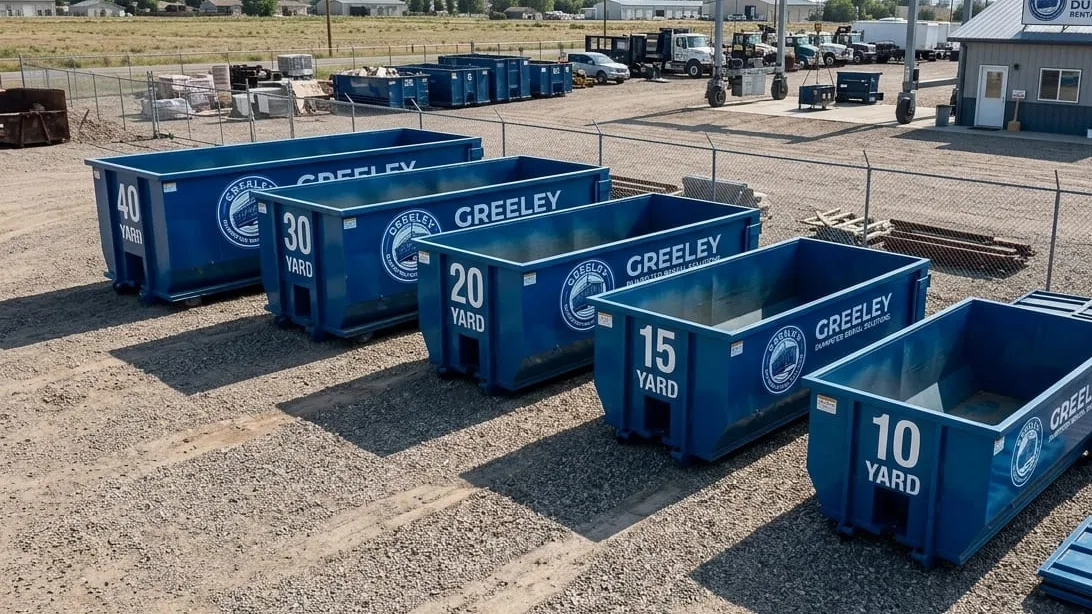
10-yard. The heavy-debris box. Concrete, brick, masonry, dirt, sod, tile, a small patio removal, a chimney takedown. It is short, it sits neatly on a single-car driveway, and it exists because dense material reaches lawful payload in a small footprint. It is also the right box for a single bathroom gut. If someone quotes you a 10 for a whole-house cleanout, they have not thought about it.
15-yard. The in-between. A large single-room remodel, a kitchen tear-out, a garage clearance, a modest deck removal, a mixed load that is heavier than furniture but lighter than rubble. It is the box we reach for when the 10 is going to be tight and the 20 is going to sit half empty.
20-yard. The default in this market, and the one we deliver most. A whole-house declutter, a full interior remodel, a basement finish demolition, a large estate clearance, a rental turn on a family-sized house. It takes bulky material without running out of walls and it still fits on a normal Greeley driveway.
30-yard. The volume box. New construction, a large addition, a commercial tenant-finish tear-out, a hoard-level cleanout, a multi-unit turnover where three or four apartments empty in the same week. Light and bulky is what it is for.
40-yard. The largest, and it is a commercial and industrial answer far more often than a residential one. Big volume, low density, plenty of room to maneuver a truck. On a residential lot in the older half of Greeley it is usually the wrong tool, not because of the debris but because of the driveway.
Our full size comparison sets the dimensions side by side if you want to picture it against your own driveway.
Why the 20 is the Greeley default
A 20-yard handles a full declutter of a three- or four-bedroom house — furniture, closets, boxes, the garage, the shed — and it does it without the container becoming an obstacle in the street. Step up to a 30 if you are also emptying a finished basement, or if the load is dominated by mattresses and bulky furniture, which eat volume at an extraordinary rate. Step down to a 15 if you are clearing one floor, one garage or one room.
Basements matter here more than a chart from somewhere flatter would suggest. Greeley’s own adopted residential code, Table R301.2(1) in Title 22 Chapter 3, sets a frost line depth of 30 inches. Where you have to dig thirty inches for footings anyway, the marginal cost of going down for a full basement is small, and basements are ordinary in this climate. A basement cleanout or a basement finish demolition is a normal Greeley job, and it is normally a 20.
Roofing never goes in a 30 or a 40
This is the one rule we will not bend. Asphalt shingle tear-off is dense, and it reaches lawful payload long before it fills a large box. Ordering a 30 for a roof does not get you more roof in a container; it gets you a container you are not allowed to move, and a second trip you are paying for.
Greeley makes the point harder than most markets. Northeastern Colorado averages seven to nine hail days a year and sits in the most hail-prone corridor in the country, so roofs here get replaced on a hail clock rather than a wear clock. And in a city where nearly half the housing predates 1980, a tear-off is frequently coming off a house that has been re-roofed twice already. Multiple layers of shingle is the densest ordinary residential debris there is. Two 10-yard boxes, or a 15 swapped once, will almost always beat one large box on a re-roof. Our roofing container page works through the layer math; the hail and tear-off guide goes further into what a Front Range storm season actually does to a roof.
What an old house puts in a box
Roughly 29 percent of Greeley’s entire housing stock was built between 1960 and 1979. Those houses are hitting sixty, and they are being renovated. Here is what that means for sizing.
- Plaster and lath is dramatically heavier than modern wallboard. A room stripped to the studs in a 1950s house does not weigh what the same room weighs in a 2005 house.
- Cast iron waste stack and old galvanized supply come out of mid-century houses in lengths that are awkward to load and heavy to haul.
- Sewer lateral and water service replacement is a recurring job on old housing, and with a 30-inch frost line the trench is deep. Excavated spoil is the heaviest thing most homeowners ever put in a container, and it belongs in a 10 with dirt and nothing else.
- Old flooring in layers — sheet vinyl over linoleum over hardwood over subfloor — adds up quickly.
- Ceramic tile and mortar bed from a 1960s bathroom is effectively masonry.
None of that is a reason to be nervous. It is a reason to describe the house, not just the room, when you call.
Concrete, dirt and masonry get their own container
Clean concrete, brick, block, asphalt, dirt and sod are usually handled as a separate, dedicated load in a small box, because mixing them with general debris ruins both. If you have a patio and a garage clearance to do in the same fortnight, that is two containers, not one, and the two together are usually cheaper than one contaminated load. Our heavy debris page explains why the separation matters and what counts as clean.
Rental turns and move-outs are a different sizing problem
Greeley is 39.1 percent renter-occupied, against 22.1 percent across Weld County as a whole, and the University of Northern Colorado at 501 20th Street enrolled 8,807 students in fall 2025 by the university’s own count, in a city of about 115,073 people. Leases turn in early May and again in mid-August, and a turnover load is nothing like a demolition load: it is furniture, mattresses, particle-board shelving and bagged household goods, all light, all bulky, all volume and almost no weight.
For a single apartment turn, a 10 or a 15 is usually right. For a house that has been let to four or five people, a 20. For a landlord clearing several units in the same week, a 30 on site for the week beats three separate small deliveries. We work through the calendar and the code side of this in the move-out and rental turnover guide.
What the City’s own clean-up will not take
Greeley runs an annual Spring Clean-Up over two days in early May, and it is a genuinely useful municipal service — for the right material. It takes appliances, furniture, mattresses, scrap metal and tires. It expressly does not take, in the City’s own published words, “Construction or demolition debris (including dirt, concrete, masonry, plywood, and similar materials).” It also turns away bagged loads outright. So the output of a bathroom gut, a roof, a deck removal or a basement demolition has no municipal route at all. That is the whole argument for a container, and we set it out fully in what the City clean-up will not take. The Clean-Up line is 970-350-9336 if you want this year’s dates from the City directly.
Where the box can sit, whatever size it is
Two constraints apply to every container we place, and they are worth knowing before you choose a size.
Five feet from a combustible wall. The City of Greeley has adopted the 2021 International Fire Code at Greeley Municipal Code § 22-454, effective 1 January 2023, and the Greeley Fire Department says the same in its own words. Greeley makes no amendment to Section 304, so the model rules apply as written. Under Section 304.3 a dumpster must not be stored inside a building or placed within five feet of a combustible wall — and every roll-off we place is far over the threshold in that section, so the five-foot rule applies to all of them. Placement questions go to the Greeley Fire Prevention Bureau on (970) 350-9510.
Private ground or public ground. On your own driveway, yard or lot, no City right-of-way permit is in play. The moment any part of the box sits in the street or on a sidewalk, the City is explicit that it is a permit matter — see our Greeley permit guide, or call Public Works Permits on 970-350-9881.
And if the job involves digging rather than just placing — footings, a sewer line, fence posts — call 811 or 800-922-1987 first. Colorado law requires two business days’ notice, not counting the day you call, and white-lining the area before you request the locate. Colorado 811 publishes the process. Weld County is dense with buried oil and gas gathering and flow lines as well as ordinary utilities, and Greeley’s own development code has a section headed “Recordation of Flow Lines.” Take the locate seriously.
Things that do not go in any size of container
Sizing is irrelevant for a short list of materials, because they cannot go in the box at all. Paint, solvents, thinners, pesticides, pool chemicals and automotive fluids are household hazardous waste. Weld County runs a free facility for them at 1311 North 17th Avenue in Greeley, open Tuesday, Thursday and Saturday from 8 to 5, on (970) 400-2217, with a limit of 200 pounds per household per visit, nothing in a container larger than five gallons, no leaking containers and no plastic bags. It is free to every Weld County resident. Note that the facility does not take electronics or appliances.
Electronics have been banned from Colorado landfills since 1 July 2013 under C.R.S. § 25-17-303, so televisions, monitors and computers need an e-waste route. Tires are refused locally and handled separately. Our what can go in a container in Colorado guide is the full list.
Just tell us the job
The fastest way to get the right box is to describe the house and the work rather than to guess at a number: how old the house is, what is coming out, whether there is concrete or dirt in it, how long the driveway is, and whether anything has to sit in the street. We size it from there. Call (970) 888-6911 and we will tell you which container we would actually send, including when the answer is a smaller one.
More on how we deliver and protect the surface underneath in the driveway protection guide, and the common questions are collected on our FAQ page. If you are outside the city limits, the service areas page sets out where we run.
Questions this guide did not answer? Call (970) 888-6911. We would rather spend two minutes on the phone than have you order the wrong container.